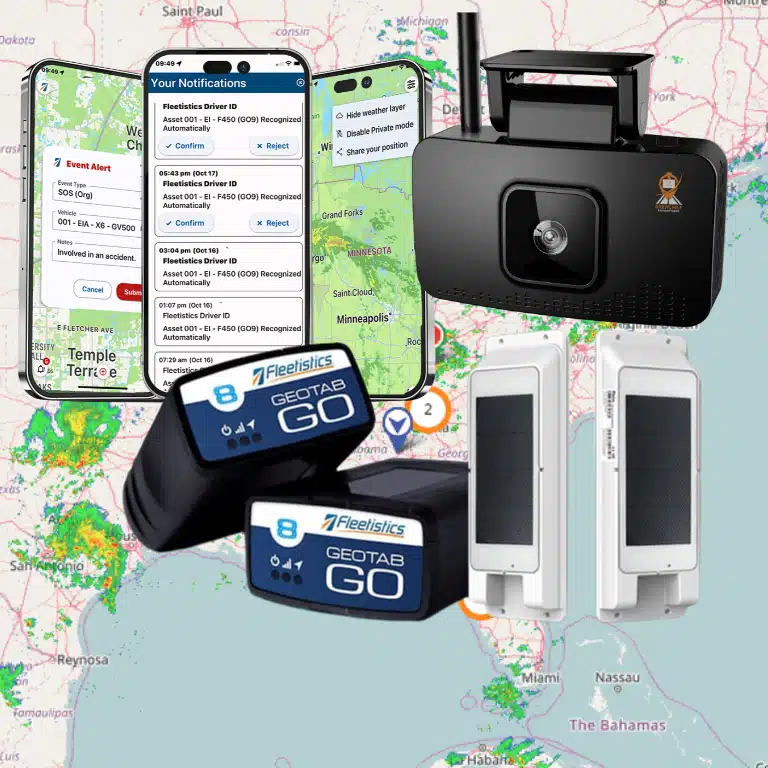


A fuel management system for small business should make fuel use easier to see and improve without adding more work than it saves. Start with the questions you need answered: which vehicles use the most fuel, where avoidable idling or miles occur, and whether changes are improving cost per mile or per job. The right fit may combine telematics, fuel-card records, and a few consistent operating practices rather than a large, complicated platform.
Talk with Fleetistics about your fleet’s fuel goals
What should a small business fuel management system actually do?
A useful system connects fuel activity to the vehicles and work that caused it. It should help you spot patterns, identify exceptions, and decide what to change. It does not need every possible feature on day one.
For a smaller operation, useful fuel management often has four parts:
- Fuel visibility: Records of purchases, fuel levels where available, and vehicle mileage or engine data that help establish usage.
- Operating context: Location, routes, stops, engine-on time, and vehicle assignments that make the numbers explainable.
- Actionable reporting: A short list of exceptions and trends that someone can review regularly.
- A repeatable response: Clear steps for checking a suspicious transaction, reducing unnecessary idling, or revising a route or schedule.
That distinction matters. A report showing a high fuel total is not enough if it cannot tell you whether the cause was more miles, heavier work, a change in vehicle assignment, or a possible data problem. Connecting fuel information with GPS fleet tracking and operating context can help turn a total into a question the manager can investigate.
Which fuel visibility features matter most?
Begin with the records you already have. Fuel-card statements, receipts, odometer readings, dispatch records, and vehicle telematics each provide part of the picture. A system becomes more useful when those records can be compared by vehicle, driver or team, time period, and business activity.
Can you connect purchases to the right vehicle?
Look for a practical way to associate each fuel purchase with a vehicle and date. Depending on your process, that may come from fuel-card records, a driver entry, or an administrative import. Decide who will investigate missing or unusual records. A technology platform cannot resolve an incorrect vehicle number if no one owns the correction.
Review a sample month before committing to a new workflow. Can you match most purchases to the correct vehicle? Are odometer readings available? Do vehicle names and fuel-card assignments stay current when vehicles move between teams? Fixing these basic records often improves the value of any later analysis.
What can telematics add?
Telematics can add vehicle location, distance, engine activity, and other available data to the purchase record. GPS information can help explain an unusual trip or a detour; engine data may support idle-time or fuel-level monitoring when the vehicle and installed equipment support it. Do not assume that every vehicle reports every measurement. Confirm the data available for your vehicle types and hardware.
Check what the system actually measures, how often it updates, and whether the report labels estimates separately from direct records. For example, fuel-level data may fluctuate with vehicle movement or equipment characteristics. Treat an alert as a prompt to investigate, not proof of misuse. Fleetistics offers GPS tracking hardware options, and the right configuration depends on the vehicles and information you need.
How should you handle incomplete or inconsistent records?
Expect some gaps when you bring together data from cards, receipts, vehicles, and dispatch. A missed odometer entry or a vehicle reassignment can make a valid purchase look unusual. Define a short correction process: flag the record, check the receipt or card detail, verify the vehicle assignment for that date, and document the correction. Keep the original data visible where possible so a reviewer can understand what changed.
Also decide how to treat transactions that cannot be matched. Keep them in an exception category rather than forcing an uncertain match. This helps you distinguish a real data-quality problem from a change in consumption. If one vehicle repeatedly has unmatched purchases, review card controls, driver instructions, and administrative setup before drawing conclusions from its fuel metrics.
How can idling data help control fuel use?
Idling is worth reviewing when vehicles spend meaningful time with the engine on while not moving, but context matters. A service vehicle may need to power equipment, maintain a safe cabin temperature, or wait at a job site. The purpose is to distinguish necessary engine time from a pattern the team can reduce—not to impose the same target on every role.
Use a simple process:
- Establish a baseline. Compare engine-on time while stationary across a representative period.
- Separate work types. Review the routes, job types, shifts, and vehicle roles behind the largest totals.
- Ask drivers and supervisors. Confirm the reason for recurring idle periods before setting a policy.
- Choose one change. For example, adjust dispatch timing, reduce early arrivals, or reinforce an existing idle-reduction practice where safe and appropriate.
- Review the same measure again. Check whether the change reduced unnecessary idle time without disrupting service or safety.
Make expectations clear and explain what data is collected and why. Transparent notice, fair rules, and driver input help establish trust and improve the quality of operational feedback. Fleet teams can use Fleetistics’ guidance for introducing GPS tracking and building employee buy-in as a starting point for the conversation.
For example, imagine a service team sees repeated stationary engine time shortly before its first appointments. The useful next step is not to assume every minute is avoidable. Compare the stops with scheduled start times, ask dispatch whether job assignments are released early, and ask drivers whether loading or equipment use explains the pattern. If some waits are avoidable, test a dispatch adjustment for a subset of routes, then check both idle time and on-time arrival. Keeping service quality in view prevents a fuel initiative from simply shifting the cost into missed appointments or rushed driving.
How do routing and dispatch affect fuel costs?
Fuel use is affected by more than vehicle condition. The sequence of stops, avoidable backtracking, empty miles, traffic, and poorly timed assignments can all shape how much driving a job requires. A small fleet may not need a separate advanced routing program immediately. It does need a dependable way to compare planned work with actual trips and identify repeatable waste.
Start by looking for patterns rather than trying to optimize every route at once. Are two vehicles repeatedly crossing the same area? Do urgent jobs create avoidable return trips? Are vehicles dispatched from a location that adds distance? Does a schedule leave drivers waiting with engines running? These are operational questions that route and location history can help answer.
When reviewing an apparent detour, compare the day’s actual constraints with the plan. A driver may have changed course because of a road closure, a customer request, a delivery window, or a vehicle restriction. Review the same corridor or job type across multiple days before concluding that the route itself is the problem. A manager can then test a specific adjustment, such as assigning nearby calls together or changing the order of two flexible stops, and record what happened.
When route planning is a clear need, compare it with your dispatch process and the constraints of your work. Appointment windows, vehicle capacity, driver schedules, customer priority, and road conditions may matter as much as the shortest distance. Fleetistics has information on fleet routing and route-planning integration and how weather data can inform fleet operations. Consider those capabilities when they address a real workflow, not simply because they appear on a feature list.
For broader operational context, the U.S. Department of Energy provides information on energy and transportation. Use authoritative material to inform general efficiency discussions, then evaluate your own fleet’s routes and records rather than assuming a published recommendation applies identically to every vehicle or job.
Which reports help a small fleet take action?
Useful reports answer a recurring management question and identify the next step. A dashboard with many charts can still be hard to use if it does not help a supervisor decide what to check on Monday morning.
Consider tracking a compact set of measures:
- Fuel purchases by vehicle and period: Review unusual changes and confirm vehicle assignments.
- Fuel cost per mile: Compare similar vehicles and work periods, while noting differences in workload and vehicle type.
- Distance and idle time: Look for operational changes that may explain fuel trends.
- Exception follow-up: Track how many alerts or anomalies were reviewed and resolved, not only how many were generated.
- Service and maintenance context: Check whether recurring fuel or performance changes overlap with maintenance needs.
Set a consistent reporting period and define each measure. If one month uses purchase date and another uses transaction-posting date, the comparison may mislead. If vehicles have different duties, avoid ranking them as though they perform identical work. A fleet analytics metrics approach can help managers select measures that connect to decisions rather than collecting numbers without a purpose.
How can you turn exceptions into a repeatable review?
For each flagged item, record what was checked, the explanation, the action taken, and who owns the follow-up. Keep categories simple: confirmed data issue, expected operational reason, possible process improvement, or unresolved. This prevents the same question from being investigated from scratch every week and shows whether alerts are useful.
Set a threshold for escalation based on the scale of your operation and the reliability of its data. A single small difference may not deserve the same attention as a repeated unexplained pattern across several periods. Avoid setting thresholds so tight that normal variation generates a flood of alerts. Review a sample of flagged and unflagged records to find out whether the rules are surfacing meaningful exceptions or overlooking the issues you care about.
Which fuel management approach fits your business?
There is no single setup that suits every small fleet. A company with a few vehicles and straightforward routes may begin with disciplined records and basic tracking. A growing operation with several teams may need consolidated reporting and stronger exception workflows. Compare approaches against your current problem, the quality of your records, and the time available to manage the system.
| Approach | Best fit | What it can provide | Tradeoffs to consider |
|---|---|---|---|
| Fuel-card and receipt process | Very small fleet or early baseline | Purchase records and a starting point for cost review | May require manual matching; offers limited route or idle context on its own |
| GPS tracking and telematics | Fleet needing trip, location, and operating context | Vehicle activity data that can help investigate distance, stops, and idle patterns | Available data varies by device and vehicle; someone must review exceptions |
| Integrated fuel and fleet reporting | Teams combining transaction records with vehicle data | A more connected view by vehicle, period, and operating activity | Data setup and ongoing record quality matter; confirm required integrations |
| Routing or dispatch optimization | Operations with repeated route overlap or scheduling issues | Tools to review stop sequences, distance, and route constraints | Needs accurate addresses, schedules, and operational rules; shortest is not always workable |
Use the table as a starting point, not a maturity ladder. A focused solution that solves the biggest verified issue may be better than purchasing several modules at once. Fleetistics’ fleet fuel economy overview and fuel-saving tips offer related ideas for examining consumption and operational habits.
How should you calculate whether the system is worth it?
Estimate value using costs and operating measures you can verify. Avoid crediting a system with every improvement that happens after installation. Fuel prices, seasonal work, staffing, vehicle mix, and customer demand can all change during the same period.
A practical baseline can include:
- Total fuel spending and gallons purchased for a defined period.
- Miles driven, separated by vehicle or relevant work group.
- Idle time or route exceptions, if the data is available and reliable.
- Administrative time spent collecting, correcting, and reviewing records.
- One or two service measures, such as completed jobs or on-time performance, to check for unintended effects.
Then estimate the costs of the solution: subscription, equipment, installation where applicable, setup time, training, and the staff time required to review reports. Compare equivalent periods and document what changed. A useful calculation might be: net measured value = verified fuel or labor savings plus other documented benefits, minus system and implementation costs. Keep fuel savings separate from productivity gains so the same benefit is not counted twice.
Fleetistics documents fuel savings of up to 14% as a possible result in relevant fleet contexts; that is not a guaranteed outcome for every business. Your own baseline, operating conditions, and follow-through determine whether a particular change helps. Fleetistics’ fleet savings and ROI resources can help structure the questions to validate before scaling.
For a simple example, suppose a business is considering whether to add tracking and reporting to an existing fuel-card process. It can first record a representative baseline, then choose one change tied to an observed issue, such as checking recurring route overlap. During the review, compare fuel and miles for similar work, note any changes in job volume or vehicle assignments, and include staff time and system costs. If the data are too incomplete to make a fair comparison, the immediate priority may be fixing records rather than claiming a savings result.
What should you check before choosing a platform?
Ask vendors to demonstrate your actual workflow, not just show a generic dashboard. A useful review should cover how the system fits your vehicles, records, staff, and decisions.
- Vehicle and data fit: Confirm supported vehicle types, device options, and which fuel-related measurements are available.
- Record integration: Ask how fuel-card or transaction data is imported, matched, corrected, and exported.
- Reporting clarity: Request an example report that flags an exception and shows how a manager investigates it.
- Ease of use: Identify who will maintain vehicle and driver records and how much time routine review takes.
- Privacy and communication: Understand what driver information is collected, who can access it, and how the program will be explained to employees.
- Modularity: Determine whether you can begin with the functions you need and add capabilities as the fleet’s needs change.
- Support and implementation: Clarify who helps configure the system, train users, and resolve data questions.
Bring practical examples to a demonstration. Show a sample fuel transaction, a vehicle that changed teams, and a route that included an unusual stop. Ask the vendor to explain which fields are imported, what the system flags, how a manager corrects a mismatch, and whether the audit history remains clear. Also ask what happens if a vehicle has no supported fuel-level signal. These questions help you separate available functions from assumptions about what a platform can measure.
Fleetistics works with Geotab technology and provides modular fleet management solutions. The platform and setup should be matched to fleet type and operating goals rather than assuming a small business needs an enterprise-scale rollout. Its fleet maintenance and diagnostics tools may also be relevant when fuel trends need to be considered alongside vehicle condition.
How can you implement fuel management without overcomplicating it?
Keep the first phase small enough that people can complete it consistently. Choose a limited group of vehicles or one operation, establish clean records, and decide what result would justify a broader rollout.
- Write down the problem. Examples include unexplained fuel-cost variation, weak purchase records, excess idle time, or repeated route overlap.
- Choose a baseline. Define the vehicles, dates, and measures you will compare. Note unusual workload or seasonal factors.
- Assign ownership. Name the person who corrects records, reviews exceptions, and follows up with operations or drivers.
- Configure only relevant alerts. Start with a manageable number. Too many low-value notifications can make important events easier to miss.
- Train the people who use the data. Explain the purpose, how to interpret a report, and how a driver or supervisor can flag missing context.
- Review after a defined interval. Check data quality, time spent, operational effects, and progress against the original problem before expanding.
Make the trial operationally specific. For instance, select vehicles that perform comparable work, identify the manager responsible for reviewing exceptions, and set a recurring time to discuss findings with dispatch or supervisors. Keep a short decision log with the date, issue, explanation, change tested, and outcome. That record helps you distinguish a useful process from an isolated good week and makes it easier to teach the routine to another manager.
Before expanding, ask whether users can complete the recurring tasks without constant reminders. Check how often records need correction, whether alerts produce actionable questions, whether drivers understand the policy, and whether the chosen measures still match the business problem. If the pilot reveals an integration gap or inconsistent assignments, resolve it before enrolling more vehicles. A staged rollout lets you improve the process while limiting disruption.
The evaluation period should fit the complexity of your fleet and the time needed to see representative work. Do not assume one duration is right for every business. For more on making fleet technology useful in daily work, see Fleetistics’ fleet training resources and its overview of tracking maps for fleet operations.
Book a conversation about the right fuel-tracking fit
Frequently Asked Questions
Does a small business need a dedicated fuel management platform?
Not always. If you have a few vehicles and can reliably match purchases to vehicles, a well-managed fuel-card or receipt process may be enough to establish a baseline. A platform becomes more valuable when you need vehicle activity, route, idle, or exception data connected to fuel records.
Can GPS tracking show exactly how much fuel a vehicle uses?
Not in every setup. Fuel-level or consumption information depends on the vehicle, device, and available data. GPS tracking can provide useful location and distance context, but confirm the specific fuel measurements and their limitations before relying on them for reporting.
How often should a manager review fuel reports?
Choose a schedule that matches transaction volume and the speed at which you can act. A small fleet may start with a weekly exception review and a monthly trend check. Adjust the frequency if a safety, loss, or operational issue calls for faster follow-up.
Should fuel cost per mile be compared across every vehicle?
Only when the vehicles and work are reasonably comparable. Vehicle type, load, route, terrain, and job requirements can affect consumption. Compare like with like where possible and use the metric to prompt investigation rather than treating it as a complete performance score.
How long should we evaluate a system before expanding?
Allow enough time to check setup, record quality, user adoption, and a representative period of work. The right interval depends on fleet size, seasonality, and the problem you are measuring. Agree on the review date and success measures before the evaluation begins.
Ready to make fuel data useful?
Start with one clearly defined problem, connect the records that explain it, and review the results with the people who manage the work. If the system makes decisions easier and the measured value fits your business, you can expand in deliberate steps. Use these resources as a starting point as you plan the next step for your fleet.
Contact Fleetistics to discuss a right-sized fleet solution

Previous: Fuel saving tips for fleets | Next: Fleet fuel economy