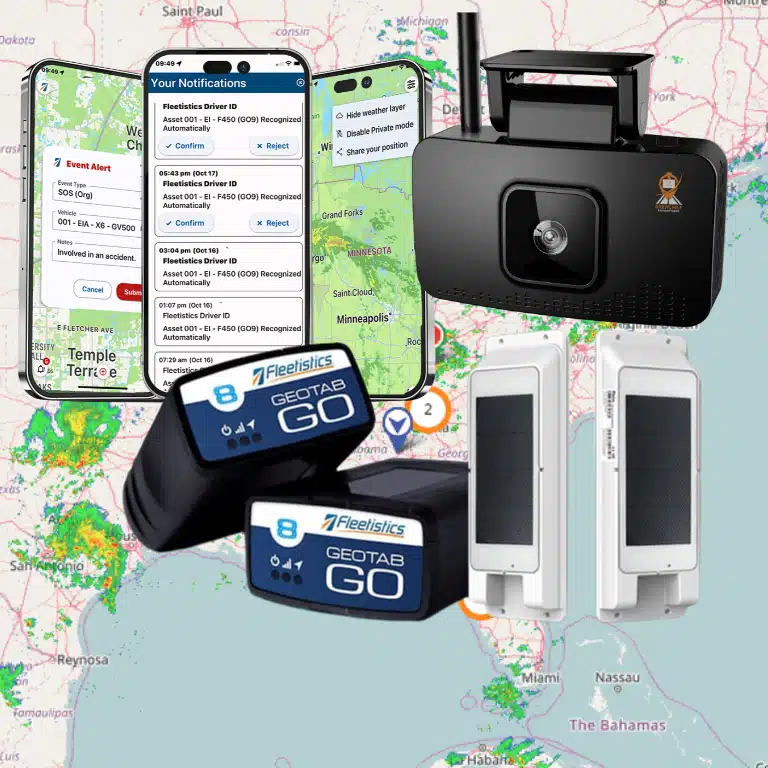


Vehicle diagnostics telematics gives fleet teams a way to see developing vehicle problems before a warning light becomes a roadside failure. Instead of waiting for a driver to report a symptom. Managers can use available engine and vehicle data to identify alerts, check context, prioritize action, and document what happened.

Speak With a Fleet Management Consultant
What is vehicle diagnostics telematics?
Vehicle diagnostics telematics combines onboard vehicle information with a connected fleet platform. Depending on the vehicle, device, configuration, and data available from the manufacturer, that information may include diagnostic trouble codes. Engine status, battery voltage, odometer readings, fault descriptions, fuel-related signals, coolant temperature, or other operating measurements.
The important point is that telematics does not create unlimited visibility into every mechanical component. It reports the data that the vehicle and installed equipment make available. A useful program therefore treats an alert as a decision signal, not as a complete diagnosis from a distance.
This distinction helps prevent two common mistakes. First, a manager should not ignore a code because the vehicle still appears to be operating normally. Second, a manager should not authorize an expensive repair based only on a generic alert without confirming the condition with a qualified technician.
Why should fleets use diagnostic data before a failure?
A vehicle failure is rarely expensive only because of the repair itself. The event may also interrupt a customer appointment, leave a driver waiting for help. Require a replacement vehicle, create a missed delivery, or pull a supervisor into an emergency response. Diagnostic data gives the fleet an opportunity to move from reaction to controlled planning.
The U.S. Department of Energy explains that telematics can help fleet managers monitor vehicle utilization and identify vehicles for replacement, pooling, or downsizing, while also supporting early detection of engine faults. Read the federal telematics guide for more context on using connected vehicle data in fleet management.
For a working fleet, earlier awareness can support several practical outcomes:
- Better scheduling: a developing issue can be reviewed during a planned service visit instead of during the busiest route.
- More consistent triage: dispatch, operations, and maintenance teams can work from the same alert and vehicle history.
- Less avoidable downtime: repeat warnings can be investigated before they become an immobilizing event.
- Clearer maintenance records: teams can connect the initial alert, inspection, repair, and return-to-service decision.
- Stronger replacement decisions: recurring faults and repair patterns can be considered alongside utilization and age.
Diagnostics should not be sold as a guarantee that failures will disappear. The value comes from improving the timing and quality of decisions.
What data can vehicle diagnostics telematics provide?
Available information varies by make, model, year, powertrain, connected device, and configuration. A fleet should confirm the actual data set during evaluation rather than assuming that every vehicle exposes the same signals.
| Data or alert type | What it can tell the fleet | Useful next step |
|---|---|---|
| Diagnostic trouble code. | A vehicle system has reported a condition that needs review. | Check the code, severity, driver notes, and repair history before assigning priority. |
| Battery or electrical alert. | Voltage or charging behavior may need attention. | Review vehicle symptoms and schedule testing before the next critical assignment. |
| Engine or emissions-related alert. | The powertrain or emissions system has reported an abnormal condition. | Follow manufacturer and technician guidance; do not clear the alert without resolving the cause. |
| Operating temperature signal. | Conditions may be outside the expected operating range. | Contact the driver when appropriate and determine whether the vehicle should be stopped. |
| Odometer or engine-hour data. | Usage can be compared with maintenance intervals. | Build service reminders around the correct vehicle measure. |
| Repeated or unresolved alert. | An issue may be returning or not fully corrected. | Escalate for history review and technician inspection. |
These signals become more useful when they are joined with location, utilization, driver reports, work orders, and service history. A single code can be ambiguous. A code that repeats after a repair, appears during a demanding route, or affects a high-priority vehicle deserves a different response.
How should a fleet turn an alert into a maintenance decision?
A repeatable workflow is more valuable than a long list of alerts. The following process keeps the response focused.
1. Confirm the vehicle and alert
Start with the unit number, vehicle identity, timestamp, current status, and alert description. Confirm that the alert belongs to the correct vehicle and is not a stale event, duplicate notification, or communication issue.
2. Check operational context
Review whether the vehicle is moving, assigned to an active job, carrying equipment, or approaching a service area. Look at recent mileage, engine hours, route conditions, driver comments, and related alerts. Context helps separate a lower-priority review from an immediate safety concern.
3. Apply a severity rule
Define in advance which conditions require immediate driver contact, same-day inspection, the next available service appointment, or simple monitoring. The rule should be based on the vehicle maker’s guidance, your maintenance policy, the nature of the alert, and the possible safety or operational impact.
4. Communicate without guessing
Tell the driver and maintenance contact what is known, what is not known, and what action is required. Avoid telling a driver that a vehicle is safe merely because it is still moving. Also avoid diagnosing a component when the available telematics data only identifies a system-level code.
5. Record the outcome
Capture the inspection result, repair decision, parts or labor information, and return-to-service status. If the alert was dismissed, record why. A documented outcome makes recurring problems easier to find and gives managers a better basis for future maintenance planning.
Fleet teams can compare this workflow with a broader fleet maintenance software process. The goal is not to create more administrative work. It is to make the work already performed easier to prioritize, assign, and verify.
Discuss your vehicle diagnostics workflow with Fleetistics
What should the alert triage matrix look like?
Many fleets benefit from writing the response rules before the first large volume of alerts arrives. A triage matrix gives dispatch and maintenance a shared language. It also reduces the chance that one manager treats a recurring condition as routine while another treats the same condition as an emergency.
Immediate action may be appropriate when the alert is paired with a safety concern, a serious operating symptom, or manufacturer guidance to stop. The responsible person should contact the driver, document the decision, and arrange the correct inspection or assistance. The manager should not ask the driver to interpret a technical code alone.
Same-day review can fit alerts that do not require an immediate stop but could affect reliability or a critical assignment. Maintenance can review history, contact the driver, and determine whether the unit should finish its work, return to a facility, or be reassigned.
Planned service may fit a lower-risk condition that is stable, understood, and safe to defer under the fleet’s policy. The alert should still become a work item. Give it an owner and a due date. “Monitor” should never mean “forget.”
For example, a one-time low-voltage alert on a lightly scheduled vehicle might receive a prompt battery test. The same alert on a vehicle with repeated starting problems and an early-morning route may deserve same-day attention. The difference is not the label alone. It is the combination of alert, history, symptoms, assignment, and consequence.
How do alerts improve preventive and predictive maintenance?
Preventive maintenance follows a planned interval, such as mileage, engine hours, time, or manufacturer guidance. Diagnostic alerts add a condition-based layer. They may show that a vehicle needs attention sooner than its next scheduled interval, or that a vehicle can be reviewed with more context before a routine appointment.
Predictive maintenance goes further by looking for patterns that may precede a problem. For example, a manager may compare repeat codes, rising repair frequency, increased engine hours, utilization, and time between service events. This does not mean the platform can predict every failure. It means the fleet can identify risk patterns earlier and investigate them deliberately.
Use these approaches together:
- Preventive layer: keep required and manufacturer-recommended service on schedule.
- Diagnostic layer: respond to reported conditions and investigate severity.
- Pattern layer: examine repeat events, repair history, and vehicle utilization.
- Decision layer: repair, monitor, replace, or change the assignment based on evidence.
For more on using vehicle data to plan maintenance, see Fleetistics’s VMRS maintenance reporting resource and predictive fleet maintenance guidance. These resources address the management process around data, not just the alert itself.
How can maintenance teams use alert history more effectively?
An alert becomes more valuable when it remains connected to the vehicle’s history. Before approving a repair, look for earlier events involving the same system, recent parts replacement, open work orders, and notes from the driver or technician. This simple review can prevent a team from treating a recurring issue as a new and unrelated event.
After service, use the same record to verify closure. Was the cause identified? Was the repair completed? Did the alert disappear, return, or change? Was the vehicle released for normal duty, restricted to a different assignment, or held for more work? These questions create a useful loop between telematics and maintenance operations.
History can also improve parts and labor planning. If a group of similar vehicles produces the same alerts at comparable usage levels. A manager can discuss inspection procedures, parts availability, technician capacity, and replacement timing with more evidence. The data does not make the decision automatically, but it makes the discussion more precise.
What limitations should fleet managers explain to their teams?
Clear expectations protect trust. Diagnostic telematics is powerful, but it is not a substitute for a physical inspection or a qualified repair decision.
- Data availability varies. Two vehicles may expose different parameters even when they perform similar work.
- Codes need context. A code may identify a system or condition without identifying the failed part.
- Connectivity can be interrupted. A delayed message does not necessarily mean the vehicle had no issue, and an absent message does not prove that every system is normal.
- Alerts require governance. Someone must own triage, escalation, technician communication, and closure.
- Maintenance policy still matters. Telematics should support, not replace, manufacturer guidance, inspections, and applicable safety requirements.
Fleets should also confirm whether a proposed device uses a plug-in or hardwired configuration. A hardwired option is not automatically an upgrade; it may involve tradeoffs in installation, serviceability, data availability, or vehicle compatibility.
Teams should explain these limits to drivers as well as managers. A driver report about a smell, noise, vibration, temperature change, or warning light may add context that a data feed cannot capture. Conversely, a driver may not see an alert that appears in the platform. A good process welcomes both sources and gives each a defined place in triage.
How can you implement vehicle diagnostics telematics without overwhelming the team?
Start with a narrow operational question. Examples include: Which alerts have caused unexpected downtime? Which vehicle groups have repeated repair events? Which units should receive a maintenance review before a high-demand season? A focused question makes it easier to select useful alerts and define success.
- Inventory the fleet: group vehicles by type, age, duty cycle, powertrain, and operating region.
- Identify the cost of disruption: estimate missed work, substitute vehicles, towing, overtime, and customer impact.
- Choose a short alert list: begin with conditions that can change a real maintenance or dispatch decision.
- Assign owners: name the person who receives alerts, the person who evaluates them, and the person who closes the work.
- Set escalation windows: define immediate, same-day, scheduled, and monitor categories.
- Review results: track alert-to-inspection time, repeat alerts, unplanned downtime, repair completion, and avoidable emergency events.
- Expand carefully: add data only when the team can act on it and the signal improves a decision.
A pilot can make this process easier. Select a representative vehicle group rather than only the newest or easiest units. Include different duty cycles if the fleet has them. For the first review period, ask whether alerts were understandable, whether owners responded on time, and whether technicians received enough context to act. Fix the workflow before adding more alert types.
Integration can also matter. An open fleet platform may connect telematics information with maintenance, routing, fuel, safety, or business systems. Fleetistics describes its approach as modular, with Geotab technology, professional support, and an open ecosystem. Review the fleet management platform overview and training resources when assessing how your team would use the information day to day.
Which measurements show whether the program is working?
Do not judge diagnostics by the number of alerts generated. Measure whether the alerts improve decisions and reduce avoidable disruption.
| Measurement | What to compare | Why it matters |
|---|---|---|
| Alert response time. | Time from alert receipt to review or driver contact. | Shows whether the workflow is actionable. |
| Repeat alert rate. | Alerts that return after a repair or dismissal. | May reveal incomplete repairs, weak triage, or a recurring vehicle problem. |
| Unplanned downtime. | Roadside events and out-of-service hours before and after implementation. | Connects diagnostics to operational continuity. |
| Scheduled versus emergency work. | Share of repairs completed during planned service windows. | Indicates whether maintenance is becoming more controlled. |
| Repair closure quality. | Work orders with a documented cause, action, and return-to-service decision. | Improves accountability and future analysis. |
| Cost by vehicle or group. | Repair, towing, substitute, and interruption costs over time. | Supports repair-versus-replace and utilization decisions. |
Set a baseline before changing the process. A small fleet may start with a spreadsheet review and a few priority alerts. A larger organization may need role-based queues, maintenance integrations, and regular exception reviews. The right level depends on fleet structure and internal capacity.
Review results on a regular schedule, such as weekly for open urgent alerts and monthly for trends. Separate volume from value. A rise in alerts may mean better visibility, not worse vehicle health. Look instead at how many alerts were actionable, how quickly they were closed, and whether the resulting work prevented disruption.
What should you look for in a diagnostics and maintenance platform?
Ask a prospective provider to demonstrate the complete workflow, not only a map with a warning icon. You should be able to see how the system identifies a vehicle, displays the alert, records history, assigns responsibility, and confirms closure.
Useful evaluation questions include:
- Which diagnostic data is available for each vehicle class in your fleet?
- How quickly are alerts delivered, and how are delayed communications shown?
- Can users distinguish new, acknowledged, recurring, and resolved alerts?
- Can the platform connect diagnostic events with maintenance records and vehicle history?
- Can alerts be filtered by severity, group, location, vehicle type, or assigned owner?
- What training and implementation support is included?
- Can the solution scale from a small operation to a larger, more complex fleet without forcing every vehicle into the same configuration?
Fleetistics has served fleets since 2001 and supports modular fleet management solutions built around Geotab technology. The team can help evaluate hardware, configuration, diagnostic visibility, and maintenance goals rather than treating every fleet as identical. You can also review related GPS tracking hardware options and tracking map capabilities as part of a broader evaluation.
A practical demonstration should include an ordinary alert, a repeated alert, and a missed or delayed communication. Ask who receives each event, how the system prevents duplicate work, and what the technician sees. Also ask how data is retained and exported for maintenance reviews. These details often determine whether a platform becomes part of daily work or remains an underused dashboard.
Book a Fleet Diagnostics Discussion
Frequently Asked Questions
Can vehicle diagnostics telematics identify the exact part that will fail?
Not always. A diagnostic code may identify a system or condition but still require testing by a qualified technician. Use the alert to prioritize review and provide context, not to replace inspection.
Does every vehicle provide the same diagnostic information?
No. Available data depends on the vehicle, model year, manufacturer, powertrain, connected device, and configuration. Confirm the expected data for each vehicle group before setting program targets.
Should every diagnostic alert stop a vehicle?
No. The response depends on the alert, manufacturer guidance, symptoms, operating conditions, and your safety policy. Define escalation rules with maintenance and safety leaders so drivers are not asked to make unsupported mechanical judgments.
How is diagnostic telematics different from scheduled maintenance?
Scheduled maintenance follows planned intervals. Diagnostic telematics adds condition-based information that may prompt earlier review, support better prioritization, or reveal recurring patterns between service visits. Both approaches belong in a disciplined maintenance program.
Ready to use vehicle data before failures?
A practical diagnostics program turns vehicle data into timely review, clear ownership, and better maintenance decisions without pretending that an alert can replace expert inspection. Contact Fleetistics to discuss your vehicles, available diagnostic data, maintenance workflow, and the decisions you want to improve before selecting a configuration.
Next and previous posts: Previous: Predictive Fleet Maintenance | Next: Fleet Analytics Metrics.