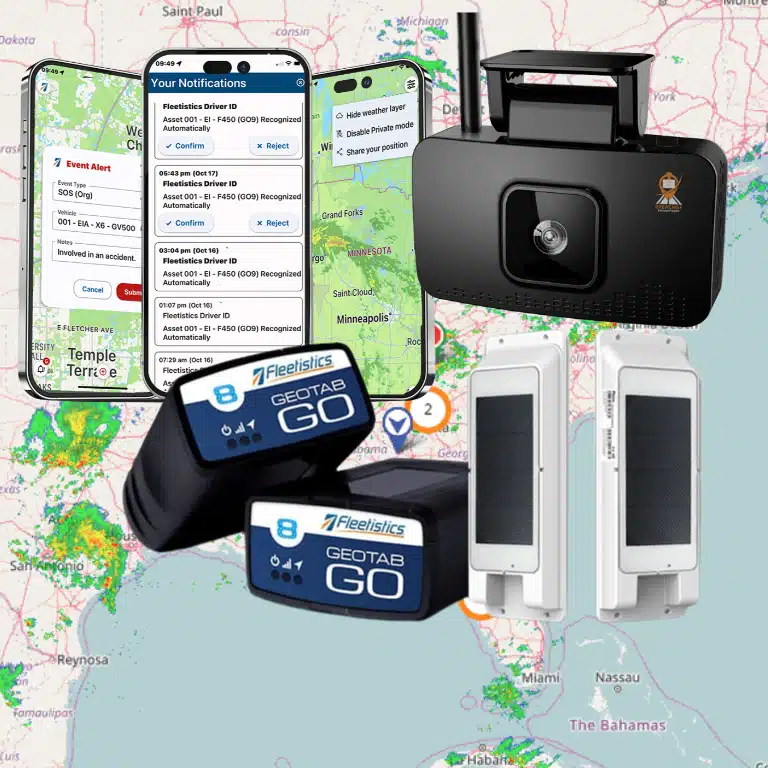

A maintenance calendar can tell you when service is due, but it cannot always tell you what a vehicle is experiencing today. That distinction matters when a recurring fault code, changing engine data, or heavier-than-usual usage signals a developing problem before the next scheduled inspection.
Predictive fleet maintenance uses engine diagnostics, fault-code alerts, usage patterns, and maintenance history to identify service needs based on asset condition. Instead of relying only on fixed time, mileage, or usage intervals, you can prioritize the right repair, schedule it around operations, and verify whether the issue was resolved. The goal is not to predict every failure, but to give your team earlier, better-supported decisions.

Talk with Fleetistics about your fleet maintenance goals
That approach works best when data leads to a defined workflow, with clear alert thresholds, technician ownership, and follow-through. First, it helps to separate predictive maintenance from preventive maintenance and understand what each method can contribute to fleet availability.
What Is Predictive Fleet Maintenance?
Predictive fleet maintenance uses vehicle condition and operating data to help you decide when an asset may need service. Instead of waiting for a breakdown or relying only on a fixed calendar, you monitor signals such as diagnostic information, fault codes, mileage, usage, and maintenance history. The goal is a better-timed maintenance decision, not a promise that every failure can be predicted.
In practical terms, the process connects four activities: collecting data, identifying a meaningful change, assessing its urgency, and assigning the right maintenance response. A warning that deserves immediate attention should not be handled the same way as a recurring code that can be reviewed during the next planned service visit. Your team still applies technical judgment, manufacturer guidance, and safety procedures.
How does it differ from guessing?
A guess might be based on a driver saying that a vehicle “does not feel right,” or on a technician’s experience with a similar asset. Those observations can be useful, but predictive maintenance adds measurable evidence. Real-time engine diagnostics, for example, can provide information through a vehicle’s OBD-II interface. Exceptions and alerts can then bring a developing condition to a fleet manager’s attention for review.
That evidence is most useful when it is connected to a defined workflow. You can set rules for which fault codes require escalation, confirm whether the vehicle is still safe and available, and create a work order when service is warranted. Maintenance records and usage patterns provide additional context, so the response is based on the asset’s condition rather than an isolated alert.
What does a predictive maintenance decision look like?
Imagine a service truck reports a diagnostic code during normal operation. The fleet team reviews the code, checks the truck’s recent usage and maintenance history, and determines whether the issue requires immediate inspection or can be scheduled. If inspection is needed, the team assigns the work, coordinates the vehicle’s availability, and records the outcome. If the code is not actionable after review, the team can continue monitoring it rather than automatically replacing a part.
This approach makes fleet maintenance more deliberate. It does not replace inspections, preventive service, or technician expertise. It gives those activities better context by helping you connect what the vehicle is reporting with what your operation should do next.
How Does It Differ From Preventive Maintenance?
Preventive maintenance follows a plan. You service an asset after a set number of miles, engine hours, calendar days, or operating cycles, whether or not its current condition suggests a problem. This approach is straightforward, easy to schedule, and useful for recurring service items with known intervals.
Predictive fleet maintenance adds condition and usage data to that plan. Diagnostics, fault codes, mileage, engine hours, duty cycle, and other signals help you decide when an asset needs attention. The goal is not to predict every failure or eliminate scheduled service. It is to give your team better evidence for prioritizing work and timing repairs.
| Consideration | Preventive maintenance | Predictive maintenance |
|---|---|---|
| Primary trigger | Time, mileage, engine hours, or usage interval | Observed condition, diagnostic data, usage pattern, or exception |
| Main strength | Simple, repeatable planning for known service requirements | More informed prioritization when asset condition varies |
| Main limitation | The interval may arrive before a component needs service, or after conditions have changed | Requires reliable data, useful thresholds, and a workflow for acting on alerts |
| Best operational use | Routine inspections, fluid service, and manufacturer-directed maintenance | Early triage of faults, changing conditions, and assets that need closer attention |
For most fleets, the practical answer is a blended maintenance strategy. Keep manufacturer requirements and safety-critical inspections on their established schedules. Then use condition data to identify exceptions, adjust priorities, and investigate assets that show unusual behavior between scheduled visits.
For example, a mileage-based service can remain on the calendar while a recurring diagnostic code moves one vehicle higher in the queue. A vehicle used in severe duty may warrant a different review cadence than a lightly used unit, even when both share the same nominal service interval.
The quality of the result depends on execution. Your team needs clear alert severity rules, technician ownership, work orders, and a way to confirm that the issue was resolved. Fleetistics combines telematics, engine diagnostics, maintenance work orders, exceptions, and analytics through a Geotab-powered platform, allowing managers to shape the mix around their assets and operating model.
Which Fleet Data Signals Matter Most?
Prediction is only as useful as the information behind it. A mileage threshold alone may tell you that service is due, but it may not explain why one vehicle is wearing components faster than another. A practical predictive fleet maintenance program combines several signals, then adds the context your maintenance team needs to decide what happens next.
Engine diagnostics provide one of the most direct views into vehicle condition. Fleetistics lists real-time engine diagnostics through the vehicle OBD-II interface. That information can help surface diagnostic conditions while an asset is operating, rather than waiting for a scheduled inspection or a driver complaint. Learn more about Fleetistics engine diagnostics.
Fault-code alerts add urgency and prioritization. Not every code requires the same response, so your rules should distinguish between a condition that needs immediate attention. A developing issue that can be handled at the next service visit, and an alert that needs confirmation. The goal is not to send every signal directly to a technician. It is to route meaningful exceptions to the right person with enough detail to act.
Mileage and usage remain important because many service requirements are tied to distance, engine hours, or asset utilization. Usage data becomes more useful when paired with duty cycle. A vehicle making frequent short trips, carrying heavy loads, idling for long periods. Or operating on demanding terrain may experience different maintenance patterns from an asset with steady highway use. The same calendar interval should not automatically be treated as equivalent operating stress.
Operating conditions can also explain why similar assets produce different alerts. Geography, weather exposure, stop-and-go driving, payload, and seasonal workload may affect how a fault develops. These signals should be reviewed alongside the asset’s make, model, age, configuration, and current assignment. That context helps prevent a dashboard from turning a technically valid alert into a poor maintenance decision.
Service history and maintenance schedules complete the picture. Record what was repaired, when it was repaired, which fault codes preceded the work, and whether the issue returned. Scheduled maintenance provides the planned baseline, while diagnostic and usage data can show when the baseline needs adjustment. A maintenance platform that supports work orders and exceptions can connect the alert to an accountable task instead of leaving it in an inbox.
Data quality deserves the same attention as data volume. Confirm that devices are compatible, readings are arriving consistently, fault-code severity rules are configured, and technicians can access the relevant history. Fleetistics combines telematics, diagnostics, maintenance management, and analytics through a Geotab-powered platform, with integration options for connecting fleet information to other operational systems. That makes the important question less about collecting every possible signal and more about selecting the signals your team can interpret and use consistently.
How Does Predictive Maintenance Reduce Downtime?
Predictive maintenance reduces downtime by turning vehicle and equipment data into decisions before a developing issue becomes a roadside failure. The goal is not to predict every failure or eliminate unexpected repairs. It is to give your maintenance team earlier, better-organized information. The right person can then assess the issue and decide what should happen next.
1. An alert starts the review
The workflow begins with a meaningful signal, such as a diagnostic fault code. An engine condition change, or usage data that indicates an asset is approaching a service threshold. Fleet managers can use real-time engine diagnostics through the vehicle OBD-II interface, along with exceptions and alerts, to bring potential problems into view. Alerts should be configured around your fleet’s equipment, operating conditions, and risk tolerance. A code that requires immediate attention should not be treated the same way as a condition that can be monitored during the next service window.
2. Triage turns data into a maintenance decision
An alert is not automatically a work order. A fleet manager, maintenance coordinator, or technician reviews the code and relevant context, including recent inspections, mileage or runtime, vehicle use, prior repairs, and maintenance schedules. That triage helps the team determine whether the asset can continue operating, needs a technician inspection, or should be removed from service. Combining diagnostic information with driver inspection records can also help separate a recurring mechanical concern from a one-time or low-risk event.
3. Planned work replaces avoidable disruption
When the review confirms that service is needed, the team creates a work order with the issue, priority, parts or labor requirements, and assigned owner. Maintenance can then be scheduled around routes, shifts, technician availability, and parts delivery. This is the operational difference between a planned intervention and an emergency breakdown. The repair still requires resources, but the organization has more opportunity to coordinate them while protecting vehicle availability.
4. Verification closes the loop
After the repair, record the completed work and verify that the alert has cleared or that the condition has returned to an acceptable state. Tracking repeat fault codes, time from alert to work order, unscheduled downtime hours, and the mix of preventive versus corrective work shows whether the process is improving decisions. Fleetistics supports this workflow with maintenance work orders, diagnostics, alerts, and analytics. Its modular approach lets you match fleet maintenance capabilities to your fleet’s size, asset types, and existing systems rather than forcing every operation into the same process.
How Can You Roll Out a Predictive Maintenance Program?
A successful rollout connects vehicle data to decisions your maintenance team can act on. Use this checklist to introduce predictive fleet maintenance without disrupting current service operations or assuming that every alert requires immediate repair.
- Establish your baseline. Review the previous three to six months of maintenance records, if available. Record unscheduled downtime hours, corrective maintenance costs, repeat fault codes, time from alert to work order, preventive versus corrective work, and cost per asset. This gives you a comparison point for evaluating the program later.
- Select the assets and data signals. Start with vehicles or equipment that have recurring faults, high utilization, difficult service access, or a clear operational impact when unavailable. Confirm device and vehicle compatibility, then identify the data you will use, such as engine diagnostics. Fault codes, mileage, engine hours, duty cycle, location, inspection findings, and existing maintenance schedules. Fleetistics supports real-time engine diagnostics through the vehicle OBD-II interface.
- Define alert thresholds and severity rules. Work with a qualified maintenance lead to classify alerts as informational, monitor, schedule, or urgent. Do not treat every diagnostic code as a failure prediction. Account for asset type, operating conditions, manufacturer guidance, and whether the same code repeats. Document who reviews each severity level and how quickly they must respond.
- Choose a focused pilot group. Limit the first deployment to a manageable group of assets, such as one vehicle class, depot, route, or maintenance team. Keep the pilot long enough to observe normal operating patterns and planned service cycles. Avoid changing too many maintenance policies at once, or you will have difficulty identifying what influenced the results.
- Assign workflow ownership. Decide who receives each alert, validates the condition, creates the work order, schedules the repair, and closes the record. Connect diagnostic alerts with your maintenance process so the information does not remain in a dashboard. Fleetistics lists exceptions and alerts, maintenance work orders, engine diagnostics, and API and SDK access among its professional capabilities.
- Collect technician and driver feedback. Ask technicians whether alerts are clear, timely, and useful during diagnosis. Ask drivers or operators whether inspection and reporting workflows capture symptoms that system data may not show. Use this feedback to refine thresholds, procedures, and communication. A predictive program works best when the people closest to the assets trust the process.
- Measure operating results. Compare the pilot with your baseline using the same definitions. Track unscheduled downtime, repeat fault codes, alert-to-work-order time, preventive versus corrective work, completed work orders, and cost per asset. Look for better prioritization and earlier intervention, but do not claim a specific reduction unless your own data supports it.
- Expand in controlled stages. After reviewing the pilot, update the rules, training, integrations, and ownership model before adding more assets. Fleetistics uses a modular platform approach that can support organizations ranging from 5 to 300,000 vehicles at the platform architecture level. Scale by fleet type and operational need, while preserving the measurement framework that showed whether the rollout is working.
Contact Fleetistics to evaluate a predictive maintenance approach
Frequently Asked Questions
What is the difference between preventive and predictive maintenance?
Preventive maintenance follows a planned interval based on time, mileage, engine hours, or usage. Predictive maintenance adds current condition data, such as diagnostic readings, fault codes, and operating patterns, to help determine when service should be prioritized. Preventive schedules remain useful, while predictive signals help you adjust attention when an asset’s condition changes.
What are examples of predictive maintenance for a fleet?
Examples include monitoring engine diagnostics for abnormal readings, reviewing recurring fault codes. Comparing usage patterns across similar assets, and routing a vehicle for inspection when its condition indicates elevated risk. The practical goal is to turn a meaningful signal into a technician review or work order before it becomes an unplanned service event.
Why is predictive maintenance important for fleet operations?
It gives you more information for deciding which assets need attention first. By connecting condition data with maintenance schedules and work-order processes, your team can investigate alerts, plan service around operations, and track whether corrective work resolved the issue. It does not predict every failure, so technician judgment and accurate records still matter.
How should a fleet start a predictive maintenance program?
Start by documenting current downtime, maintenance costs, recurring fault codes, and the time from alert to work order. Then confirm device and vehicle compatibility, define alert-severity rules, assign technician ownership, and pilot the workflow on a manageable group of assets. Measure the same baseline metrics after launch before expanding the program.
Ready to Plan Your Predictive Maintenance Approach?
A practical review can help you match engine diagnostics, alert workflows, usage data, and maintenance scheduling to the way your fleet operates. Contact Fleetistics to discuss your goals and identify a sensible path for building a more informed maintenance program.