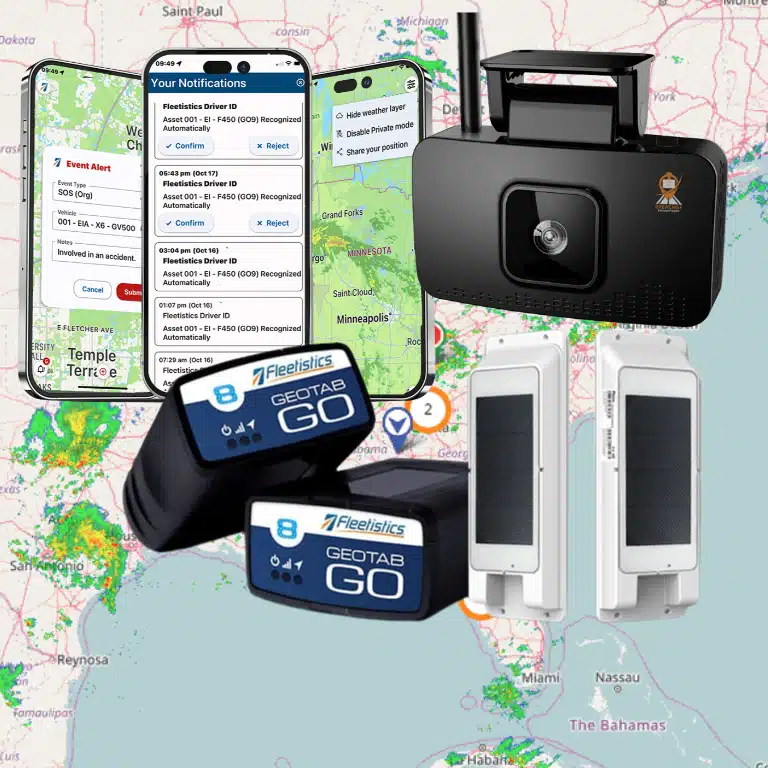
Compliance work becomes difficult when ELD records, vehicle inspections, fuel data, and driver files live in separate tools. Small gaps can create extra administrative work and make it harder to respond confidently during an audit.
Fleet compliance management software connects ELD, DVIR, IFTA, and related compliance workflows in one system, helping fleet operators automate routine reporting, organize records, and address issues before they become violations.
That does not eliminate the need for trained drivers and compliance managers. It gives them a clearer operating picture, with data captured through connected telematics and workflows that reduce manual entry. Fleet operators evaluating the technology can also review this ELD compliance guide for fleet operators for a deeper look at electronic logging requirements. First, it helps to define what this software includes and how it fits into a broader fleet operation.
Book a Demo to see how Fleetistics connects ELD, DVIR, and IFTA compliance in one dashboard your team will actually use.
What Is Fleet Compliance Management Software?
Fleet compliance management software is a centralized platform that helps you manage the records, workflows, and deadlines required to keep vehicles and drivers compliant. Instead of asking your operations team to reconcile separate spreadsheets, ELD portals, inspection forms, fuel reports, and personnel files, the software connects those activities in one operating view.
That distinction matters because compliance is not a single task. It is an ongoing process that spans driver behavior, vehicle condition, tax reporting, and documentation. A useful system helps managers see what is complete, what is approaching a deadline, and what needs attention before it becomes a violation or an audit problem.
How It Differs From Point Tools
A point tool solves one narrow problem. An ELD application may capture hours-of-service data, while a separate inspection app handles DVIRs and another system stores driver qualification files. Each tool may work well on its own, but the gaps between them create manual work and make it harder to establish a complete compliance record.
Integrated software connects those workflows. It can move relevant data between driver, vehicle, maintenance, fuel, and administrative systems, reducing duplicate entry and giving your compliance manager a more consistent source of information. Compliance platforms can streamline and automate tasks through broad software and system integrations, including add-ins designed for DOT compliance.
This connected approach is part of broader fleet telematics, where vehicle and driver data becomes useful for operational decisions rather than remaining isolated in individual applications.
Core Modules to Look For
- ELD and HOS tracking: Capture hours-of-service records, identify potential exceptions, and give managers a clearer view of available driving time.
- DVIR workflows: Record pre-trip and post-trip vehicle inspections, route defects to the right person, and document when corrective work is completed.
- IFTA reporting: Organize mileage and fuel data by jurisdiction so fuel-tax reporting is less dependent on manual reconciliation.
- Driver qualification files: Keep required driver records, certifications, and renewal dates organized instead of scattered across shared drives or paper folders.
- Maintenance records: Connect inspection findings with work orders, preventive maintenance schedules, and vehicle history.
These functions align with the common core of DOT compliance software: Driver Qualification File management, Hours of Service tracking, and vehicle inspection and maintenance records.
The right platform should be modular, so you can start with the compliance risks that matter most and expand as your fleet grows. Evaluate how well the system connects your existing data, supports your team’s daily process. And produces records you can confidently use when a regulator, customer, or internal reviewer asks for proof.
Core Features: ELD Integration, DVIR Automation, and IFTA Reporting
The value of fleet compliance management software is not simply storing compliance records. It connects driver activity, vehicle inspections, fuel data, and renewal deadlines so your team can act before a missing record becomes an operational problem. The most useful systems make each workflow visible to the people responsible for it, without forcing drivers and managers to re-enter the same information in multiple tools.
ELD integration that supports accurate records
For most motor carriers and drivers required to maintain records of duty status, the Federal Motor Carrier Safety Administration’s ELD rule applies. FMCSA explains who must comply with the ELD rule, including the relationship between ELD records and Part 395 requirements.
That does not mean every operation has identical obligations. FMCSA identifies limited exceptions, including certain short-haul operations. Drivers using paper records for no more than eight days in a 30-day period, vehicles manufactured before 2000, and drive-away-tow-away operations. Your software should help compliance managers identify which drivers and vehicles fall into each category instead of applying a blanket rule to the entire fleet.
Integration also needs to support the human side of compliance. Carriers must train compliance managers and drivers on ELD operation, proper record edits, and preventing harassment or coercion. The FMCSA carrier ELD checklist outlines these training expectations. Look for clear exception handling, controlled edits, audit trails, and workflows that make training gaps visible.
For a deeper review of requirements and implementation considerations, use Fleetistics’ ELD compliance guide for fleet operators as a planning resource.
DVIR automation that closes the inspection loop
DVIR automation turns a driver’s inspection report into an accountable maintenance workflow. A driver can submit a defect from the field, while the appropriate manager or maintenance team can review it. Assign follow-up, document the resolution, and retain the record with the vehicle’s history. That is more useful than collecting inspection forms in a folder and discovering unresolved defects during an audit or breakdown.
The key evaluation question is whether the system tracks the complete loop: inspection, defect, assignment, repair, approval, and record retention. It should also distinguish a reported issue from a confirmed repair, so managers can prioritize vehicles that need attention rather than treating every inspection as equally urgent.
IFTA reporting built from usable fuel data
IFTA reporting depends on consistent mileage, jurisdiction, and fuel information. Software can bring those inputs together from connected vehicle and fuel systems, then give managers a reviewable foundation for preparing reports. The goal is not to hide the filing process behind a button. It is to reduce manual reconciliation and make exceptions easier to investigate before submission.
Ask how the platform handles missing data, mixed asset types, corrections, and export requirements. Fleetistics supports FMCSA, ELD, DVIR, and IFTA compliance across the USA, Canada, and Mexico, with a modular approach that lets you match the workflow to your fleet. License expiration and renewal alerts are another practical control; Compliance platforms commonly use advance alerts to help prevent expired credentials from being overlooked.
When ELD, DVIR, and IFTA workflows share data and ownership, compliance becomes a repeatable operating process rather than a monthly scramble. That is the standard to use when comparing platforms.
How Compliance Software Reduces DOT Audit Risk With Fleet Compliance Management Software
A DOT audit is easier to manage when your records are accurate, current, and available without a last-minute scramble. Fleet compliance management software creates a central workflow for driver qualification files, hours-of-service records, inspections, maintenance, and training evidence. That gives you a clearer view of open issues before they become audit findings.
The goal is not simply to store more data. It is to make required actions visible, assign responsibility, and preserve a dependable record of what happened and when. Core DOT compliance functions commonly include DQF management, HOS tracking, and vehicle inspection and maintenance records, all of which support a more organized audit response.
| Audit-readiness criterion | Manual/paper compliance | Automated compliance software |
|---|---|---|
| Record accuracy | Information may be spread across paper forms, inboxes, and spreadsheets. Missing signatures, outdated files, or inconsistent entries can take time to identify. | Records are organized in one workflow, with electronic submissions and status visibility that help managers identify incomplete or overdue items sooner. |
| Audit preparation time | Staff may need to collect files from multiple locations and reconstruct a vehicle or driver’s history under pressure. | Searchable records and centralized documentation make it easier to retrieve supporting evidence and focus attention on exceptions. |
| Violation flags | Maintenance intervals, license renewals, and inspection issues depend heavily on individual reminders and manual review. | Automated alerts surface approaching expirations, overdue work, and maintenance issues before they become preventable gaps. Preventive maintenance features can also reduce the risk of vehicle maintenance violations. |
| Driver training | Training dates and completion records may be tracked separately, making it difficult to confirm who received which instruction. | Training assignments and completion evidence can be tied to driver records. FMCSA guidance calls for training on ELD operation, proper record editing, and coercion and harassment rules. Review the FMCSA ELD checklist for carriers. |
Automation does not replace management judgment or regulatory knowledge. It gives your team earlier signals and a defensible record of follow-through. Configure alerts around your actual inspection cycles, assign owners for corrective actions, and review exceptions regularly. That approach helps turn audit preparation from a document hunt into a routine operating process.
Integration With Your Existing TMS, HR, and Payroll Systems
Replacing a compliance tool should not require rebuilding the rest of your operation. The strongest fleet compliance management software fits into the systems you already use, connecting vehicle, driver, dispatch, and payroll data through an open ecosystem.
Fleetistics supports more than 300 marketplace integrations, including EBE, Cummins Connect, and Navistar OnCommand. That gives your team options for connecting compliance reporting with the TMS, HR platform, payroll provider, maintenance system, or manufacturer tools already in your workflow.
How compliance data moves through the business
ELD and HOS records begin with driver and vehicle activity. As drivers operate, the system captures the information needed for hours tracking and compliance reporting. That data can then feed the TMS, helping dispatchers work from current availability and hours information instead of relying on manual updates from drivers or back-office staff.
DVIR information follows a similar path. Driver inspection reports can be connected to maintenance and asset workflows so reported defects are visible to the people responsible for repair, follow-up, and vehicle availability. This creates a clearer record from inspection to resolution, rather than leaving a defect in a separate application or paper file.
IFTA-related mileage and fuel data can also flow into reporting workflows. Instead of asking staff to reconcile multiple exports at the end of a filing period, connected systems provide a more consistent data set for review. Your accounting or payroll team can spend less time copying figures between spreadsheets and more time checking exceptions.
Less duplicate entry for HR and payroll
Driver hours affect more than DOT compliance. They may also affect timekeeping, payroll review, driver qualification processes, and internal labor reporting. When ELD data is connected to HR and payroll systems, authorized teams can reconcile hours against the appropriate driver records and identify discrepancies before payroll is finalized.
That does not remove the need for review. It gives each department a shared source of operational data, with a clearer audit trail and fewer opportunities for transcription errors. Managers can focus on exceptions, such as an unexpected edit, missing record, or mismatch between logged activity and submitted time.
When comparing platforms, evaluate integration depth rather than counting connector names. Review which fields move, how often they sync, what happens when data is missing, and whether your team can access useful reports without custom work. This fleet management software comparison is a useful starting point for evaluating that broader fit.
Fleetistics takes a modular approach, so you can connect the compliance functions your operation needs without forcing every department into the same workflow. The goal is a practical information flow across TMS, HR, payroll, maintenance, and reporting, with less duplicate entry and more dependable records.
Fleetistics Compliance Suite: What You Get From Day One
Compliance should not be an add-on you assemble after choosing a tracking platform. With Fleetistics, FMCSA, ELD, DVIR, and IFTA compliance support is built into the broader fleet management system, helping operators manage vehicles, drivers, equipment, and reporting from a connected environment. The platform supports fleets across the USA, Canada, and Mexico, so your compliance approach can scale with your operating footprint.
Compliance management is a core pillar in both the Fleetistics PRO and ONE platforms. That matters because your requirements may change as your fleet grows, adds new asset types, or expands into new regions. Instead of forcing every operator into the same package, Fleetistics uses a modular approach. You can match capabilities to your fleet size, operational model, and priorities, then add functionality as the business evolves.
Compliance expertise backed by customer advocacy
Fleetistics is a Geotab Authorized Reseller with a relationship spanning more than 20 years. That relationship gives you access to a proven telematics ecosystem, but the value is not simply the hardware or software connection. Fleetistics advocates for your operation, helping you evaluate what fits your workflows rather than leaving you to navigate the manufacturer relationship alone.
That consultative role is especially useful when compliance touches multiple teams. Drivers need practical workflows for logs, inspections, and alerts. Managers need visibility into exceptions and documentation. Leadership needs a clearer view of risk, cost, and return. The right solution should connect those needs without turning compliance into a collection of disconnected point tools.
A lower-risk way to validate the fit
Fleetistics offers a 60-day no-risk Solution Evaluation Process. Use that time to test the system against real operating requirements. Review how drivers and managers use the workflows, and validate the expected business value before making a long-term decision. A structured evaluation is more useful than choosing software based on a feature checklist alone.
Government and public-sector fleets can also use Sourcewell cooperative purchasing agreements where applicable. That can simplify the purchasing process for eligible organizations while preserving the opportunity to evaluate a solution designed around their fleet and compliance needs. Fleetistics has served fleets since 2001 and provides 24/7 support when questions arise during implementation or daily operations.
For a broader view of how compliance fits alongside safety, productivity, and efficiency, review these pillars of fleet management. The goal is not to buy the most complicated system. It is to build a practical, modular foundation that keeps compliance visible and manageable from day one.
Contact Us Today for a no-obligation walkthrough of how Fleetistics can automate your ELD, DVIR, and IFTA reporting.
Frequently Asked Questions
What are the core functions of compliance software?
Core functions typically include electronic logging device (ELD) and hours-of-service tracking, DVIR and maintenance records, driver qualification file management, license-renewal alerts, and IFTA mileage and fuel reporting. The practical advantage is keeping driver, vehicle, and reporting workflows connected instead of rebuilding records in separate spreadsheets or point tools.
Who must comply with the ELD rule?
Most motor carriers and drivers who must maintain records of duty status are subject to the ELD rule under 49 CFR 395.8(a). Limited exceptions include certain short-haul operations, drivers using paper records for no more than eight days in a 30-day period, drive-away-tow-away operations, and vehicles manufactured before 2000. Confirm your operation’s status against current FMCSA guidance: FMCSA’s ELD rule guidance.
Can compliance software integrate with a TMS, HR system, or payroll platform?
Yes, many platforms connect with transportation, workforce, maintenance, fuel, and payroll systems through integrations or APIs. Before choosing one, verify that it can exchange the specific driver, vehicle, mileage. And fuel data your team needs, and ask how exceptions are handled when information is missing or inconsistent.
Does software replace compliance training for drivers?
No. Automation can surface missing records, violations, and deadlines, but drivers and managers still need practical training. FMCSA’s carrier checklist calls for training on ELD operation, proper record editing, and preventing harassment or coercion, so pair the software rollout with documented procedures and refresher training: FMCSA’s ELD checklist.
Book a Demo for Compliance Guidance
When ELD, DVIR, and IFTA workflows need to work together, a consultative review can help you identify the right fit for your fleet and reporting requirements. Book a Demo to see how Fleetistics can support a more organized compliance process, or speak with a consultant at 855.300.0527 to discuss your goals.
Fleetistics supports fleets across the USA, Canada, and Mexico, with a modular compliance suite that connects to your existing TMS, HR, payroll, and maintenance systems. A Fleetistics representative can walk through your audit history, reporting deadlines, and current workflows, then recommend the controls that reduce manual effort and make obligations easier to manage. There is no obligation, and the 60-day Solution Evaluation Process lets you validate expected business value before committing. Contact Us Today to start the conversation.