Growth changes fleet management before most teams realize it. A spreadsheet may track vehicle assignments, but it rarely connects safety events, maintenance due dates, compliance records, utilization, and customer commitments in one dependable view.
A practical business fleet framework starts with your asset mix and operating goals, then connects the safety, maintenance, compliance, data, and integration requirements that support them. The right approach is not the most features. It is a flexible system that fits how your fleet works today and can scale as your vehicles, equipment, or watercraft expand.
You do not need to wait until a fleet becomes large to establish that framework. Define what counts as part of the operation. Mark where manual processes create risk. Then identify which decisions need better data and use that list to evaluate technology and measure return.
What Is a Business Fleet, and When Does It Need a Framework?
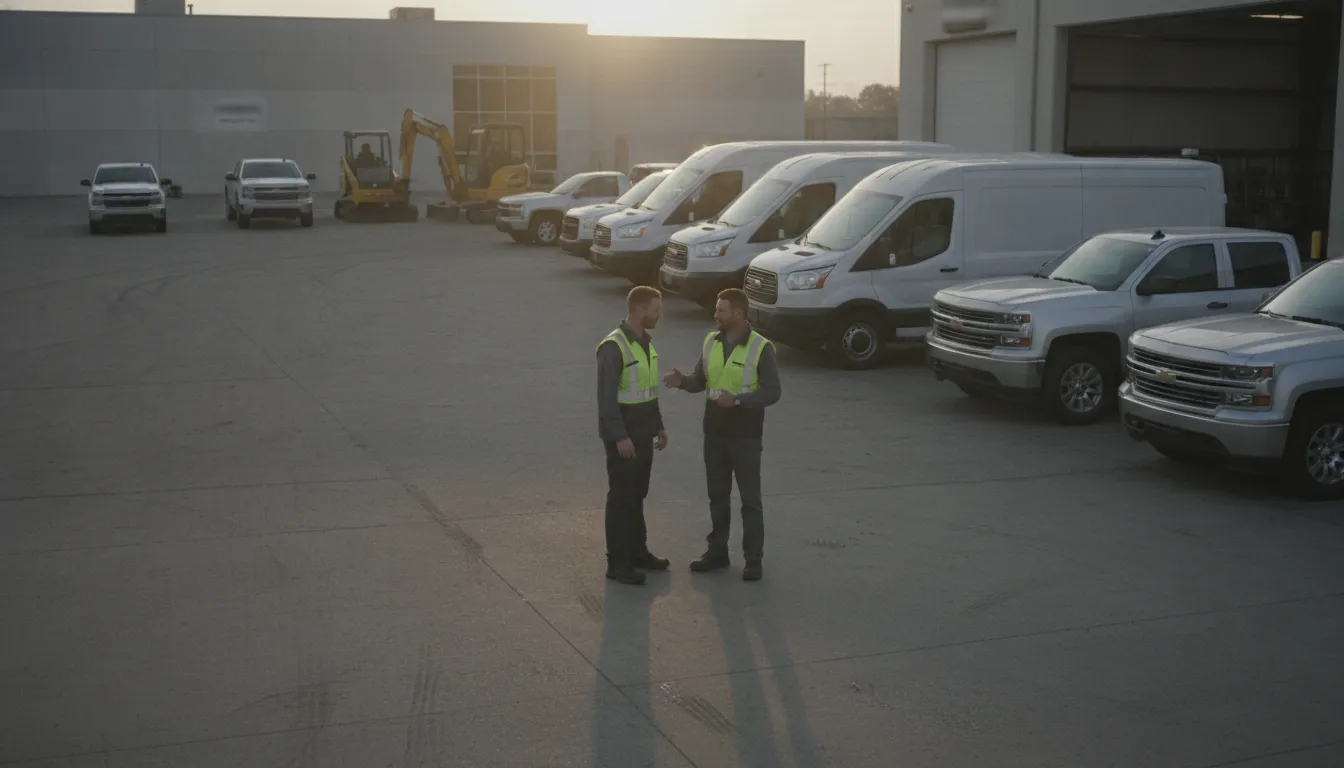
A business fleet is any group of vehicles, equipment, or watercraft used to deliver services, move people or materials, support field work, or operate the business. It may include pickup trucks, vans, service vehicles, trailers, heavy equipment, or boats. The common factor is not the asset count. It is that the business must coordinate those assets, the people using them, and the costs and risks they create.
That means two trucks can count as a business fleet. A landscaping company with two work trucks may need to manage assignments, preventive maintenance, fuel use, driver safety, equipment availability, and customer appointments. A larger operation may need more formal controls, but the underlying questions are similar: Where are our assets? Who is responsible for them? Are they available and safe? Which costs are affecting profitability?
The right time to create a framework is when informal methods stop producing dependable answers. Spreadsheets, calendars, paper inspection forms, and basic GPS visibility may work while the operation is small and straightforward. They become less effective when assets are added, service areas expand, several people share responsibility, or leaders need to connect fleet activity to productivity, compliance, and cost control. Fleet managers often have to replace manual processes while improving visibility across operations, safety, compliance, and cost control.
A framework is more than a spreadsheet and more than a tracking map. It starts with an inventory of your fleet mix and operating goals, then defines the controls and information needed to manage the business. Depending on the operation, that can include maintenance schedules, diagnostics, driver behavior alerts, inspection records, route or dispatch information, and metrics for utilization and operating cost. Compliance tools such as ELD, DVIR, or IFTA belong in the framework only when the fleet’s work and jurisdiction make them relevant.
Scale should influence the design, not dictate a one-size-fits-all purchase. Fleetistics serves operations with vehicles, equipment, and watercraft across the USA, Canada, and Mexico, with solutions designed for approximately 5 to more than 5,000 assets. Start by documenting what you operate and how work gets assigned. Mark where failures or delays occur. Note which decisions depend on incomplete information. That inventory becomes your fleet management framework and gives you a basis for evaluating technology against measurable business needs.
How Should You Map Fleet Size, Assets, and Operating Goals?
Start with an inventory, not a product shortlist. Before you compare platforms, document what your business operates, where those assets work, and which decisions are currently slowed by incomplete or scattered information. Fleet recommendations should reflect your fleet’s size, mix, operating model, and goals rather than assume every operation needs the same feature set. Fleet management framework planning is most useful when it connects each technology requirement to a specific operational need.
1. Build an asset-level inventory
List every asset by type and use. Separate road vehicles from trailers, heavy equipment, powered or unpowered machinery, watercraft, and other mobile or high-value equipment. For each asset, record its identifier, make and model, ownership or lease status, assigned team, home location, operating region, and replacement timeline. Include assets that are rarely moved. They may still represent a security, utilization, maintenance, or availability concern.
Then add the operating context. Note whether each asset is dispatched daily, assigned to a crew, shared across jobs, parked between seasonal workloads, or used only when a customer request arrives. Record duty cycle, expected hours, typical routes, job sites, and any environmental conditions that affect maintenance or availability. This prevents a business from selecting a vehicle-focused solution when its real challenge is locating equipment, understanding utilization, or coordinating a mixed fleet.
2. Map ownership, workflows, and risk
For each asset group, identify who is responsible for dispatch, inspection, maintenance approval, fueling or charging, incident review, and customer communication. Write down the current workflow, including spreadsheets, paper forms, phone calls, and separate software systems. Mark where information is re-entered, where a handoff can fail, and where managers lack timely visibility.
Next, rank the risks. These may include unauthorized use, theft, missed service intervals, underused equipment, preventable vehicle downtime, unsafe driving, or delayed customer updates. Keep the list specific. “Improve efficiency” is difficult to measure. While “reduce time spent locating shared equipment” or “identify overdue maintenance before a job is missed” gives your evaluation a useful direction.
3. Turn the inventory into requirements
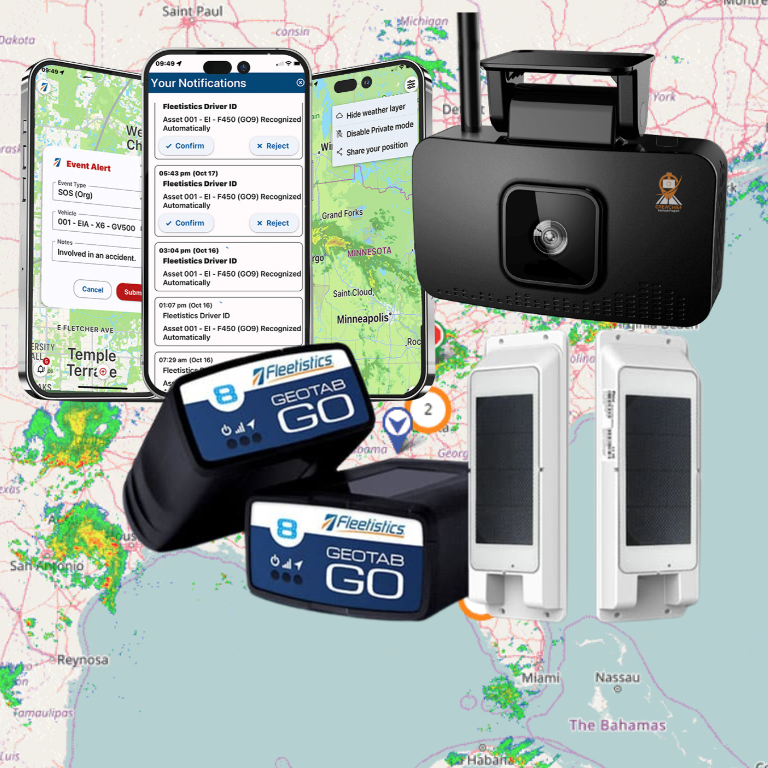
Translate each priority into a requirement and an outcome. A mixed fleet may need different combinations of GPS trackers, diagnostic devices, sensors, or dashcams, so review fleet hardware options by asset type and use case. Non-standard assets may also require location visibility, utilization data, maintenance context, and a rollout plan, which are central considerations in specialty equipment tracking.
Finally, document growth assumptions. Fleetistics describes solutions for operations ranging from approximately 5 to more than 5,000 assets. So your plan should account for acquisitions, new regions, seasonal expansion, and changing workflows without forcing an immediate enterprise deployment. Use the inventory to define a short list of must-have capabilities, useful next-stage capabilities, and metrics that will show whether the investment is working. That list gives you a defensible foundation for a tailored evaluation instead of a generic feature comparison.
Which Safety and Maintenance Controls Belong in Your Business Fleet Plan?
A growing fleet needs more than location visibility. Your safety and maintenance plan should connect what drivers do, what vehicles report, what managers review, and what your team does next. That creates a traceable process from an event or defect to coaching, repair, and an uptime decision.
Start with behavior, alerts, and usable evidence
Driver behavior monitoring can help you identify patterns such as harsh braking, speeding, rapid acceleration, or other exceptions that deserve review. Alerts should be tied to a defined response. A notification that no one investigates quickly becomes background noise, while a prioritized exception can prompt coaching before a recurring behavior becomes a collision, complaint, or avoidable repair.
Video evidence adds context when an incident occurs. AI-assisted dashcams can help your team review what happened, distinguish a preventable event from a road-condition issue, and support a consistent coaching conversation. Explore driver safety technology based on the risks your operation is actually trying to control. Do not select a camera system solely because it produces more alerts. Evaluate whether managers can review events efficiently and apply the findings fairly.
Employee transparency is part of the control design. Explain what information is collected, when monitoring applies, who can access footage or behavior records, and how the data will be used. Give drivers a way to report context or challenge an inaccurate interpretation. Written notice, consistent policies, limited access, and documented review standards help build buy-in while protecting the integrity of the program. Tracking should support safer work, not become an unexplained surveillance practice.
Connect inspections to diagnostics and work orders
Maintenance controls should combine scheduled service with condition-based signals. Telematics can provide near-real-time diagnostic information through a connected platform, while inspections capture issues a sensor may not detect. In applicable motor-carrier operations, federal guidance requires systematic inspection, repair, and maintenance, and says parts and accessories must remain in safe and proper condition. See the FMCSA inspection and maintenance requirements for the rules that apply to your operation.
Build a workflow that records the vehicle or asset, the reported defect, and the inspection date. It should also record the type of work, due date, assigned technician or vendor, and completion status. Applicable post-trip inspection reports should identify defects that could affect safe operation or cause a mechanical breakdown. A digital process makes it easier to route a defect into a work order instead of leaving it in a paper form, email thread, or spreadsheet.
Use fleet maintenance software to connect maintenance scheduling, diagnostics, and work orders. The goal is not to repair everything immediately or replace preventive maintenance with alerts. It is to give your team one process for deciding which issue requires immediate removal from service, which can be scheduled, and which should be monitored.
Review uptime as a management outcome
Review these controls together on a regular cadence. Track open defects, overdue services, repeat failures, avoidable incidents, time out of service, and completion of safety coaching. Compare the trends by vehicle class, location, route, or operating team when that comparison is fair and useful. This turns safety and maintenance data into an uptime review rather than a collection of disconnected dashboards.
As your fleet grows, add only the controls your operating model can support consistently. The right platform can combine GPS tracking, diagnostics, driver behavior monitoring, alerts, analytics, and maintenance workflows. Your policies and review responsibilities determine whether those capabilities improve daily decisions.
Which Compliance Requirements Apply to Your Fleet?
Compliance planning should follow how your business operates, where vehicles travel, what they carry, and which jurisdictions regulate them. A local service company, construction contractor, mixed-equipment operation, and interstate motor carrier may all operate a business fleet, but they do not automatically need the same compliance tools.
Start with the obligations that apply to the vehicles and drivers under your control. For motor carriers subject to applicable federal requirements, the Federal Motor Carrier Safety Administration states that carriers must systematically inspect, repair, and maintain the vehicles they control. Commercial motor vehicle parts and accessories must remain in safe and proper condition. Vehicles must not be operated in a condition likely to cause an accident or breakdown. Review the FMCSA inspection and maintenance requirements alongside the rules that apply to your operation.
Your records should make that process auditable. Maintain a clear history of each vehicle, the inspection and maintenance operations due, and the date and type of completed inspections, repairs, and maintenance. A digital workflow can connect diagnostic alerts and scheduled service to maintenance work orders. The system does not replace your responsibility to define procedures, assign ownership, and close the loop on reported defects.
DVIR requirements are also context-dependent. In applicable operations, drivers complete daily post-trip inspection reports, identifying defects or deficiencies that could affect safe operation or cause a mechanical breakdown. A fleet platform may help standardize those reports and route issues for review. Your compliance team should confirm when a report is required, what must be retained, and how repair certifications are handled under the governing rules.
ELD requirements depend on the vehicle, driver, carrier status, and operating conditions. They are especially relevant when your operation falls under applicable hours-of-service and interstate or regulated motor-carrier rules, not simply because you have company vehicles. IFTA reporting likewise depends on the jurisdictions and fuel-tax obligations associated with your operation. Do not add ELD, DVIR, or IFTA modules to a local or short-haul fleet without first confirming that the relevant rules apply. For regulated operations, ELD compliance resources can help you identify the workflow to evaluate.
Document your compliance map before selecting technology: applicable jurisdictions, vehicle classes, driver responsibilities, inspection cadence, record-retention needs, and escalation procedures. Fleetistics lists ELD, DVIR, IFTA, maintenance work orders, diagnostics, and accident reporting among its PRO capabilities. The right configuration should be matched to your fleet’s operating context rather than treated as a universal checklist.
How Do Integrations Turn Fleet Data Into Better Decisions?
Fleet data becomes valuable when it reaches the people and systems that already run your business. A GPS location that stays inside a tracking dashboard may confirm where an asset is. Connected to dispatch, maintenance, accounting, or payroll, that same data can help your team decide what to assign, repair, invoice, or review next.
Start by clarifying data ownership. Your fleet platform should make the underlying information accessible, portable, and usable in the systems your team relies on. APIs provide a structured way for software to request data. Webhooks can send an event when something happens, such as an alert or status change. SDKs help developers build fleet capabilities into an existing application. Partner applications can extend the connection without requiring your team to build every integration from scratch.
| Connected system. | Data or workflow. | Decision it can support. |
|---|---|---|
| Dispatch. | Vehicle location, availability, routing, assignments, and driver communication. | Which vehicle or crew should handle the next job, and whether the route is practical. |
| Maintenance. | Diagnostics, mileage, engine hours, inspections, work orders, and due dates. | Which asset needs attention before downtime becomes a service failure. |
| Fuel. | Fuel transactions, GPS context, idle activity, card controls, and exception patterns. | Whether fuel use reflects legitimate operations or requires investigation. |
| Accounting and ERP. | Utilization, billing details, asset status, job information, and operating records. | How to reconcile activity, allocate costs, and plan equipment or vehicle purchases. |
| Payroll and workforce systems. | Assigned work, approved activity, schedules, and relevant time records. | How to reduce duplicate entry while preserving review and approval controls. |
Fleetistics provides free API access, webhooks, SDKs, and more than 300 certified partner applications for connections to ERP, fuel, maintenance, dispatch, accounting, payroll, and other systems. Explore the available fleet integrations before you commit. Ask whether you can export your data, define which system is authoritative for each field, control permissions, and disconnect or change a partner without losing historical records.
Then create a scorecard that links data to decisions instead of collecting metrics for their own sake. Review safety events alongside utilization, maintenance status, fuel activity, service performance, and operating cost. For example, a rise in idle time may matter more on a vehicle with low utilization than on a unit serving a consistently congested route. A maintenance alert becomes more actionable when dispatch can see availability and customer commitments at the same time.
Use a short list of measures your team can act on: cost per mile or operating hour, preventable safety events. On-time completion, vehicle utilization, idle time, open work orders, days out of service, fuel exceptions, and customer-impacting delays. Fleetistics identifies reduced operating costs, improved efficiency, fewer violations, productivity gains, customer retention, and return on investment as potential buyer success measures. Your baseline and operating model determine which measures matter.
For a deeper view of how safety, utilization, maintenance, fuel, and service information can work together, review these fleet management metrics. If dispatch is the bottleneck, compare the workflow requirements in this fleet dispatch software guide. The goal is not to create another disconnected dashboard. It is to give each team the right context at the moment a decision needs to be made.
How Should You Evaluate and Roll Out a Business Fleet Platform?
A sound buying process should reduce uncertainty before it adds technology. Start by documenting the business problem, then test whether a proposed platform can improve the workflows and measures that matter to your team.
- Assess the current operation. Inventory assets, users, locations, workflows, and manual handoffs. Note where spreadsheets, phone calls, or disconnected systems create duplicate entry, delayed decisions, or missing accountability. Define the outcomes that matter, such as fewer violations, lower operating costs, higher productivity, better customer retention, or a measurable return on investment.
- Design the right-sized solution. Match hardware, software, permissions, alerts, reporting, and integrations to the fleet’s mix and operating model. A growing business may need different controls for service vehicles, trailers, heavy equipment, or regulated trucks. Avoid paying for a feature set that does not support a real workflow, but leave room for assets and teams you expect to add.
- Run a tailored demonstration. Ask the provider to show the actual decisions your managers make. Follow a vehicle from assignment to route, inspection, maintenance issue, exception, and closeout. Confirm who owns the data, how employees receive notice, what can be exported, and which systems can exchange information through APIs or integrations.
- Use a measurable pilot. A pilot or Solution Evaluation Process should have a defined scope, baseline, users, timeline, and success criteria. Track the same measures before and during the evaluation. Fleetistics describes a consultative process that moves from needs assessment and solution design to a tailored demonstration, pilot, implementation, training, and optimization. Learn more about a consultative evaluation.
- Plan implementation and adoption. Assign an internal owner, define administrator and manager roles, prepare drivers and technicians, and schedule training. Decide how alerts will be reviewed, how maintenance issues will be assigned, and how often leadership will inspect the scorecard. Technology creates value only when the organization acts on the information consistently.
- Review and optimize. After rollout, compare results with the baseline and adjust rules, reports, permissions, and workflows. Keep the original business goals visible. A platform should become a repeatable management process, not another dashboard that no one uses.
Fleetistics has served fleets since 2001 and brings long-running Geotab reseller and implementation experience to this process. The right partner should help you connect the platform to your operation and remain an advocate as the business changes.
Frequently Asked Questions About Business Fleets
What are business fleets?
A business fleet is the group of vehicles, equipment, trailers, or watercraft an organization uses to deliver work, move people or materials, or support field operations. It can include a few local service vehicles or a much larger mixed-asset operation. The management challenge is not only knowing where assets are. It is coordinating safety, maintenance, utilization, compliance, service, and cost decisions.
Is two trucks considered a fleet?
Two trucks can be treated as a fleet when the business manages them as shared operational assets. The right starting point is not a universal vehicle count. Ask whether the company needs repeatable inspections, maintenance records, driver accountability, location visibility, route coordination, or cost reporting. A simple process may be enough for a very small operation, while growth or higher risk can justify more structured tools.
When should a business move beyond spreadsheets or basic tracking?
Consider a more connected framework when information is late, duplicated, or difficult to trust. It may also help when managers cannot connect vehicle activity to maintenance or service outcomes. Growth can add assets, locations, drivers, and compliance requirements faster than the team can administer them. Start with the decisions you need to improve, then select only the capabilities and integrations that support those decisions.
Does every business fleet need ELD technology?
No. ELD requirements depend on the vehicle, driver, operation, and applicable jurisdiction. ELDs are relevant to many regulated or interstate operations, but they are not a universal requirement for every local-service or short-haul fleet. Review the specific rules that apply to your operation and use compliance tools such as DVIR or IFTA workflows only when they fit your operating context.
How should a business evaluate fleet management software?
Begin with an inventory of assets, workflows, safety and maintenance needs, compliance obligations, integrations, and success measures. Then compare the proposed solution through a tailored demonstration and a measurable pilot before committing to a broader rollout. Ask how the provider will support implementation, training, data ownership, employee communication, and ongoing optimization.
Build a Business Fleet Plan That Can Grow
The strongest fleet technology decision starts with your operation, not a feature checklist. Fleetistics can help you map your assets, clarify priorities, connect the right data, and evaluate a practical path from manual processes to better decisions.