
GSA fleet management is not just a vehicle-tracking purchase. Federal and public-sector agencies must connect mission requirements, vehicle accountability, safety, maintenance, reporting, cybersecurity, and the correct procurement path before selecting a tool. The strongest evaluation starts by separating what GSA Fleet already provides from the capabilities an agency must manage or supplement.
Learn more about Sourcewell purchasing.
What does GSA fleet management include?
GSA fleet management can refer to several related activities, including federal motor vehicle policy, GSA Fleet vehicle purchasing and leasing, agency-owned vehicle administration, telematics, maintenance, utilization, and reporting. Those are connected, but they are not one interchangeable system. An agency should define which part of the lifecycle it needs to improve before comparing fleet management software.
The General Services Administration’s Motor Vehicle Policy Customer Guide is non-regulatory guidance for federal fleet managers and covers acquisition, in-use management, disposal, and data reporting. It also distinguishes the GSA offices responsible for government-wide policy, GSA Fleet services, and administrative operations.
That distinction matters when an agency writes requirements. A tracking platform may improve operational visibility, driver accountability, maintenance workflows, or reporting, but it does not automatically satisfy every federal acquisition, records, cybersecurity, or agency-policy obligation.
What should an agency define before evaluating fleet software?
Before reviewing vendors or building an RFP, document the fleet’s mission and the decisions the system must support. A federal agency managing a pool of sedans has different requirements from an agency operating utility trucks, emergency vehicles, trailers, or mixed assets across multiple locations.
- Fleet scope: List owned, GSA-leased, commercially leased, rented, specialty, and non-powered assets.
- Operating environment: Identify locations, duty cycles, off-road work, weather exposure, cellular coverage, and shared-vehicle use.
- Accountability model: Define who assigns vehicles, approves use, reviews exceptions, and maintains records.
- Mission outcomes: Choose measurable outcomes such as utilization, response time, preventive maintenance completion, fuel control, or reduced administrative work.
- System boundaries: Identify which records must remain in GSAFleet.gov, an agency fleet management information system, a financial system, or another system of record.
This pre-work prevents a common procurement error: asking for a long feature list without identifying the operational decision each feature should improve. It also gives evaluators a way to score a platform using evidence instead of a product demonstration alone.
How should agencies evaluate vehicle visibility and accountability?
A useful fleet management tool gives authorized personnel a reliable view of vehicle status, location, use, and exceptions without creating unnecessary surveillance or duplicate records. Evaluate whether the system can show the information a fleet manager needs at the right time. Explain how data is collected, and preserve an auditable history for appropriate business purposes.
Look for operational visibility
- Current vehicle or asset location when location data is authorized and necessary.
- Trip history, mileage, engine hours, utilization, and time-at-location information.
- Vehicle status such as active, out of service, under maintenance, sold, or stolen.
- Geofenced alerts for facilities, restricted areas, service locations, or mission boundaries.
- Role-based access so dispatchers, fleet managers, supervisors, and administrators see only the information they need.
Also ask how the system handles shared vehicles, pool reservations, driver identification, offline periods, device replacement, and data corrections. A map is useful, but accountability depends on the surrounding workflow. The agency should be able to move from an exception to the responsible vehicle, time period, policy, and corrective action without reconstructing the event manually.
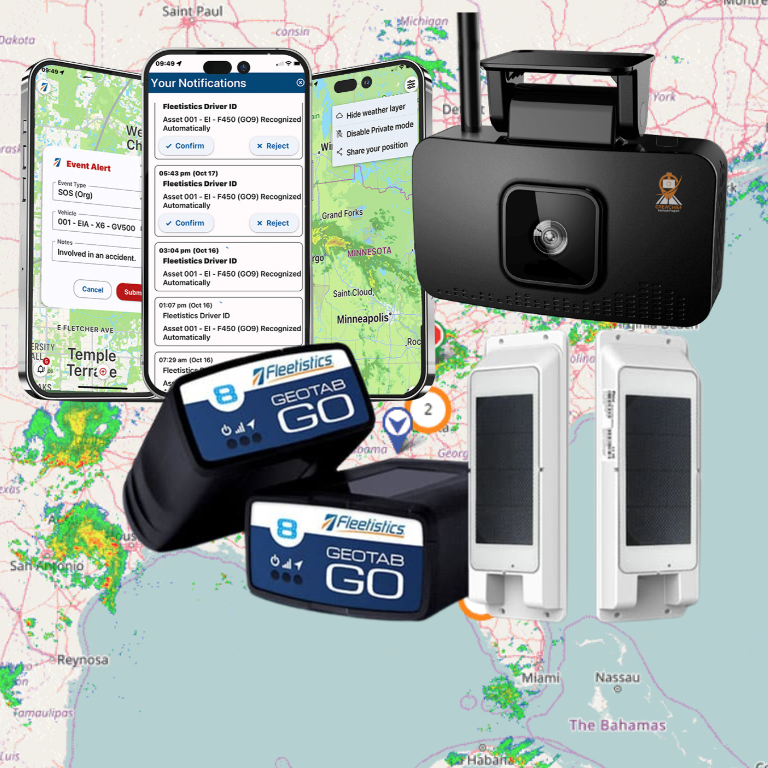
Fleetistics supports government fleet operations with GPS tracking, telematics, integrations, analytics, maintenance workflows, and mobile tools. Its government fleet management and tracking page describes capabilities that agencies can review against their own requirements, rather than treating a generic feature list as a procurement decision.
Which safety and compliance capabilities deserve the most attention?
Safety and compliance requirements should be tied to the agency’s vehicles, regulations, and operating risks. Do not assume that one telematics package or one dashboard covers every obligation. Instead, identify the records, alerts, inspections, coaching workflows, and reports that support the agency’s actual policy and regulatory environment.
Evaluation criteria may include:
- Driver behavior events such as harsh braking, rapid acceleration, speeding, seatbelt use, or unsafe following distance.
- Electronic inspection and defect workflows where they are applicable to the vehicle class and operating rules.
- Accident data, event timelines, and evidence retention that help authorized staff investigate incidents.
- Maintenance alerts based on mileage, engine hours, fault codes, or agency-defined service intervals.
- Configurable coaching and escalation steps that support consistent treatment of drivers.
- Reports that can be exported or integrated without requiring manual re-entry.
GSA’s telematics guidance describes data and capabilities available to GSA Fleet leasing customers, including engine measurements, mileage, driver coaching events, maintenance reminders, and reports. It also states that GSA Fleet does not receive GPS data from the telematics program. Agencies should confirm the scope and data ownership of the specific service they use instead of assuming that a GSA Fleet capability applies to an agency-owned or independently managed fleet.
How do maintenance and lifecycle workflows affect the evaluation?
Maintenance software should help an agency keep vehicles mission-ready, document work, and make replacement decisions with defensible data. The evaluation should cover both preventive tasks and the less predictable work created by faults, recalls, accidents, inspections, and seasonal operating conditions.
Ask whether the system can:
- Maintain a complete vehicle and equipment profile, including mileage, engine hours, specifications, and assigned location.
- Schedule preventive maintenance by mileage, time, engine hours, or agency-defined intervals.
- Capture work orders, parts, labor, vendors, costs, downtime, and completion evidence.
- Surface diagnostic data and prioritize issues that affect safety or availability.
- Track recalls, inspection defects, out-of-service decisions, and return-to-service approval.
- Report total operating cost and utilization by vehicle, class, department, location, or mission.

Maintenance data is more valuable when it connects to utilization and mission data. For example, repeated idle time, excessive engine hours, or severe duty cycles may change the maintenance plan. A system that keeps those signals separate can produce attractive reports without helping the fleet manager make a better decision.
What reporting and integration standards should an agency require?
Reporting requirements should specify the audience, decision, frequency, data fields, and retention need. A fleet manager may need daily exceptions, while finance, leadership, inspectors, procurement staff, and program managers may need different summaries. Ask vendors to demonstrate the exact report or export using representative agency scenarios.
Prioritize:
- Scheduled and ad hoc reports: Users should be able to answer routine questions without opening a support ticket.
- Data ownership and export: The agency should understand how to retrieve records in usable formats and what happens when a contract ends.
- API and integration options: Confirm whether data can connect to finance, maintenance, dispatch, identity, fuel, or records systems.
- Data quality controls: Require timestamps, source information, units, exception definitions, and correction processes.
- Accessibility and usability: Reports should work for the staff who use them, including field personnel and reviewers with different permissions.
The fleet management portal features guide is a useful reference point for questions about dashboards, alerts, reports, mobile access, integrations, support, and daily operations. Fleetistics also describes free API access and an open ecosystem with more than 300 integrations. But an agency should validate the exact endpoints, data fields, security controls, and implementation responsibilities during evaluation.
How should agencies assess cybersecurity, privacy, and governance?
Cybersecurity is a procurement requirement, not a late-stage technical detail. Ask where fleet data is hosted, how it is encrypted, how users are authenticated, how privileges are reviewed, and how incidents are reported. The agency should also determine whether location, driver, vehicle, or incident data is sensitive under its own policies and records obligations.
Include questions about:
- Encryption in transit and at rest, key management, and secure device communications.
- Single sign-on, multifactor authentication, role-based access, and administrator controls.
- Audit logs for logins, configuration changes, data exports, user changes, and incident access.
- Data retention, deletion, backup, disaster recovery, and contract-end transition.
- Vulnerability management, security notifications, incident response, and subcontractor access.
- Privacy notices, driver and employee communication, appropriate monitoring boundaries, and internal approvals.
GSA’s telematics page identifies FedRAMP authorization for its cloud-based telematics service. That is relevant to the GSA service described there, but agencies should never assume that a different product has the same authorization or control inheritance. Require the vendor to provide current, product-specific security documentation and have the agency’s security and procurement teams determine what evidence is required.
How do GSA and Sourcewell procurement paths differ?
GSA and Sourcewell can both appear in a public-sector fleet technology discussion, but they are not interchangeable. GSA is a federal acquisition and fleet-services environment. Sourcewell is a cooperative purchasing organization that conducts competitive solicitations for eligible participating government and education entities. The agency’s eligibility, authority, policies, and intended purchase determine which path is relevant.
| Evaluation question | GSA context | Sourcewell context |
|---|---|---|
| Who is the buyer? | Federal agencies and other eligible users, depending on the specific GSA offering. | Eligible participating government and education entities using a cooperative contract. |
| What is the procurement concept? | GSA Fleet services, federal vehicle sources, policy, and applicable schedules or assisted acquisition paths. | A competitively solicited cooperative purchasing contract used by participating entities. |
| What must the agency verify? | Mandatory-source rules, waivers, ordering procedures, agency policy, security, and service scope. | Eligibility, registration, contract scope, local purchasing rules, contract term, and supplier or dealer details. |
| Does the path prove a vendor has every required capability? | No. The agency still evaluates fit, security, implementation, and requirements. | No. The contract provides a purchasing path, not a substitute for agency due diligence. |
Sourcewell explains its cooperative purchasing process, including solicitation, registration, contract selection, and supplier contact. The Geotab contract page identifies contract 102924-GEO and lists GPS fleet tracking, telematics, dash cams, asset tracking, fuel management, driver tracking, routing, and related services. Agencies should verify current terms and follow their own procurement rules before relying on any cooperative contract.
Fleetistics has served fleets since 2001 and is a long-running Geotab partner. That experience can be relevant when an agency evaluates implementation, training, integrations, and ongoing support. It should not be read as a claim that Fleetistics holds a GSA contract. For a separate overview of Sourcewell purchasing considerations, see Fleetistics’ Sourcewell fleet management procurement guide and its government fleet tracking Sourcewell contract guide.
What should a practical GSA fleet management scorecard contain?
A scorecard turns broad requirements into a repeatable decision. Weight the criteria according to mission risk and document what counts as acceptable evidence. A polished demonstration should not outweigh a missing integration, unclear data-retention policy, or untested workflow.
| Category | Evidence to request | Evaluation question |
|---|---|---|
| Visibility | Live workflow, history, status changes, and exception alerts. | Can authorized staff find the right vehicle and explain its recent activity? |
| Safety | Event rules, coaching workflow, incident timeline, and retention settings. | Can the agency move from an event to a documented response? |
| Maintenance | Preventive schedule, work order, fault, recall, and downtime reports. | Can staff keep vehicles ready and show why work was completed? |
| Reporting | Scheduled report, export, API documentation, and data dictionary. | Can every required audience receive accurate information without re-entry? |
| Security | Authorization, audit, encryption, incident, and retention documentation. | Can the agency manage risk throughout the contract lifecycle? |
| Implementation | Deployment plan, training, support model, milestones, and references. | Can the agency adopt the system without creating a second manual process? |
Run a scenario-based pilot or structured demonstration using the agency’s own decisions. Test a vehicle assignment, an out-of-service event, a maintenance escalation, a report export, a user-permission change, and a contract-end data request. Capture what worked, what required manual intervention, and what the vendor could not demonstrate.
FAQs: GSA fleet management
Does GSA fleet management mean every agency must use one tracking platform?
No. GSA fleet management includes policy, vehicle acquisition, leasing, agency-owned fleet administration, telematics, and reporting. An agency must determine which services and systems apply to its vehicles, authority, mission, and procurement path.
Does GSA Fleet telematics provide GPS location data to GSA?
GSA’s telematics page states that GSA Fleet does not receive GPS data from that program, while describing other vehicle and operational data elements. Agencies should confirm the data scope for the specific service they are evaluating.
Is Sourcewell the same as GSA?
No. GSA is associated with federal fleet policy, services, and acquisition channels. Sourcewell is a cooperative purchasing organization that conducts competitive solicitations for eligible participating government and education entities. Each agency must verify eligibility and follow its own rules.
Can Fleetistics claim a GSA contract because it supports government fleets?
No. Supporting government fleets or being a Geotab partner does not establish that Fleetistics holds a GSA contract. Agencies should verify contract status directly through the applicable official procurement source and evaluate Fleetistics separately for implementation, support, integrations, and platform fit.
What is the first step in evaluating a government fleet management tool?
Document the fleet’s mission, vehicle types, systems of record, reporting needs, security requirements, and measurable outcomes. Then test candidate tools against realistic workflows instead of comparing feature names alone.
Build an evidence-based fleet technology evaluation
The best GSA fleet management decision connects procurement rules to daily operations. Start with the agency’s mission and data boundaries, score visibility, safety, maintenance, reporting, security, and implementation evidence, and keep GSA services distinct from Sourcewell cooperative purchasing. That process gives procurement teams a clearer record of why a solution fits.
Speak With a Fleetistics consultant to plan an evidence-based fleet management evaluation.