Sourcewell Fleet Management Procurement Guide
Public-sector fleets need modern telematics, safety, maintenance, and reporting tools, but traditional procurement can turn a clear operational need into months of bid documents, committee reviews, and vendor comparisons. Sourcewell fleet management procurement gives government, education, nonprofit, and tribal agencies a cooperative purchasing path that can reduce friction while preserving a competitive, documented buying process.
Planning a fleet technology purchase? Speak with a Fleetistics consultant to review Sourcewell options, Geotab capabilities, and the right deployment path for your agency.
For fleet leaders, the value is practical. Instead of starting every GPS tracking, dash cam, asset tracking, or fleet analytics project from zero, eligible agencies can use competitively solicited contracts that have already gone through a public procurement process. That can help teams move faster, compare solutions more confidently, and focus internal time on requirements, implementation, training, and results.
What Is Sourcewell Fleet Management Procurement?
Sourcewell fleet management procurement is the use of Sourcewell cooperative purchasing contracts to buy fleet technology, services, and related solutions. Sourcewell is a government service cooperative that competitively solicits contracts for use by participating public agencies. For fleet buyers, those contracts can include categories such as GPS fleet tracking, telematics devices, dash cameras, asset tracking, fuel management, routing, dispatching, finance and leasing, tires, parts, and related services.
Sourcewell describes its fleet program as a way to connect agencies with competitively awarded contracts for vehicles, parts, telematics, fuel, fleet management, and more. The goal is not to remove procurement discipline. The goal is to give agencies a trusted contract vehicle that can reduce duplicated work and help purchasing teams access pre-competed supplier options.
Fleetistics supports public-sector buyers that want to use cooperative purchasing for fleet management technology. Fleetistics is a long-running Geotab distributor and supports government fleet operators with solution design, implementation, training, reporting, and ongoing support. Agencies evaluating Sourcewell cooperative purchasing can use Fleetistics to understand how Geotab-powered fleet management fits their operational goals.
Why Cooperative Purchasing Matters for Government Fleets
Government fleet managers are under pressure to do more with limited staff, aging assets, tight budgets, and public accountability. Procurement teams must document fair competition and fiscal responsibility, while operations teams need practical tools that improve safety, utilization, compliance, and service delivery. Cooperative purchasing helps bridge that gap.
A cooperative contract can matter because it gives a qualified agency access to a contract that has already been competitively solicited. That can reduce the burden of writing a full request for proposal, collecting vendor responses, scoring submissions, and negotiating terms for every purchase. The agency still follows its own procurement policies, but it may be able to move through the process with a stronger starting point.
For fleet management technology, the timing advantage is meaningful. If a public works department needs better visibility into snowplows, a city fleet needs more reliable mileage and maintenance data, or a public safety fleet needs telematics reporting, a long procurement cycle can delay operational improvements. Sourcewell helps teams spend less time recreating contract work and more time confirming requirements, stakeholder buy-in, and deployment readiness.
How Sourcewell Can Reduce Procurement Friction
The biggest friction in fleet technology procurement is rarely a single approval. It is the accumulation of steps: defining specifications, checking vendor eligibility, comparing pricing structures, confirming contract language, coordinating legal review, and answering stakeholder questions. Sourcewell can reduce that friction in several ways.
1. It starts with a competitive contract process
Sourcewell contracts are built through a formal solicitation process. For agencies allowed to use cooperative purchasing, this can provide documentation that the supplier relationship was competitively established. Purchasing teams can then focus on whether the contract fits their local rules and the agency’s specific use case.
2. It shortens the path from need to solution review
Instead of waiting for a new RFP to be written and released, fleet teams can evaluate solutions already available through the cooperative contract. That can help departments move from problem identification to solution design faster, especially when they already know the operational issues they need to solve.
3. It supports budget transparency
Public agencies need clear pricing, contract documentation, and a defensible purchasing path. Sourcewell contracts can give finance and procurement stakeholders a cleaner framework for review. The purchasing conversation can shift from “How do we start the bid process?” to “Does this contract meet our policy, budget, and fleet requirements?”
4. It reduces duplicated administrative work
Many agencies face similar fleet problems: idle time, fuel waste, unauthorized use, missed maintenance, incomplete odometer data, safety incidents, and limited reporting. Cooperative purchasing reduces the need for every agency to rebuild the same contract framework independently.
What Fleet Management Solutions Can Be Purchased Through Sourcewell?
Sourcewell’s fleet category covers a broad set of products and services. For technology buyers, the most relevant areas often include GPS fleet tracking, telematics devices, dash cameras, asset tracking, fuel management, routing, dispatching, driver tracking, and data intelligence for fleets.
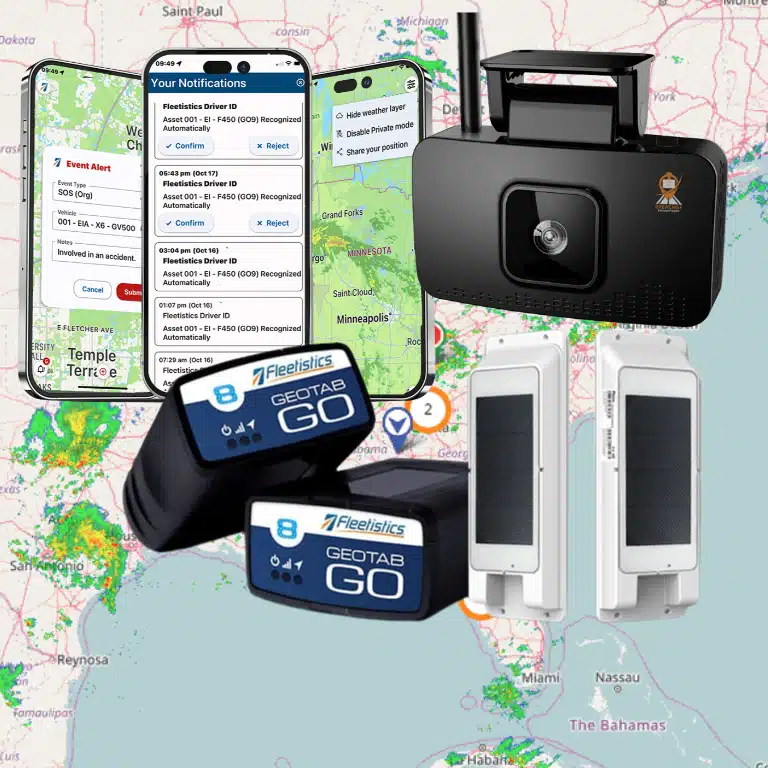
The current Geotab Sourcewell contract lists access to data-driven GPS fleet tracking solutions, GO9 telematics devices, AI and data intelligence for fleets, fleet dash cams, asset tracking, fuel management and monitoring, driver tracking, routing and dispatching, harnesses, training, and related services. For agencies that need an integrated platform instead of a single point tool, that breadth matters.
Fleetistics helps agencies connect those capabilities to specific public-sector priorities. A government fleet management solution might combine real-time GPS tracking, engine diagnostics, proactive maintenance reporting, driver safety tools, and configurable dashboards. A public works operation may prioritize route visibility and asset utilization. A public safety agency may focus on reliability, response readiness, and driver behavior data. A finance team may care most about fuel use, lifecycle costs, and defensible ROI.
When Should an Agency Consider Sourcewell?
Sourcewell is worth considering when a public-sector fleet has a clear operational need and wants a more efficient purchasing path. It can be especially useful when the agency already knows the category of solution it needs, but does not want to spend months recreating a competitive bid process for common fleet technology.
Common triggers include:
- Replacing manual mileage, fuel, or maintenance tracking with automated telematics data.
- Standardizing GPS tracking across departments, divisions, or mixed fleet assets.
- Improving driver safety with behavior monitoring, alerts, dash cameras, and coaching workflows.
- Reducing fuel waste through idle monitoring, route optimization, and exception reporting.
- Supporting compliance with better data for inspections, reporting, and maintenance records.
- Giving department heads and administrators clearer dashboards for fleet performance.
Sourcewell is not a shortcut around good planning. Before purchasing, agencies should still define their fleet size, asset types, reporting needs, internal users, installation requirements, data retention expectations, integration needs, and success metrics. A cooperative contract can simplify procurement, but it does not replace a disciplined implementation plan.
A Practical Procurement Checklist for Public-Sector Fleet Buyers
The most successful fleet technology purchases start before the order is placed. Use this checklist to prepare for a Sourcewell-based fleet management procurement process.
Define the operational problem
Be specific about the problems the project must solve. “We need telematics” is too broad. Stronger examples include reducing idle time, automating odometer capture, improving preventive maintenance compliance, tracking seasonal assets, documenting driver behavior, or giving administrators better vehicle utilization reports.
Confirm procurement eligibility and policy fit
Ask your procurement team whether your agency can use Sourcewell cooperative purchasing and what documentation is required. Some agencies may need board approval, legal review, contract comparison, or internal purchasing forms before moving forward.
Map stakeholders and users
Fleet technology affects more than the fleet office. Include procurement, finance, IT, department heads, drivers, union representatives if applicable, risk management, and leadership early enough to reduce late-stage objections.
List required capabilities
Prioritize must-have requirements before reviewing products. For example, a city may need engine diagnostics, maintenance reminders, driver scorecards, fuel reporting, asset tracking, or integrations with existing systems. Fleetistics’ modular approach helps agencies match the solution to the actual requirement instead of overbuying.
Plan implementation and training
Deployment includes device selection, installation, user permissions, dashboard configuration, alert rules, reporting schedules, driver communication, and training. Fleetistics supports customers through implementation and ongoing support so the technology produces measurable operational value after purchase.
Define ROI measures
Before launch, decide how success will be measured. Common metrics include fuel use, idle time, preventive maintenance completion, utilization, speeding events, harsh driving events, unauthorized use, downtime, and administrative time saved. Fleetistics’ consultative process helps agencies identify ROI before and after deployment.
How Fleetistics Supports Sourcewell Buyers
Fleetistics combines Sourcewell procurement support with hands-on fleet technology expertise. That is important because a contract vehicle alone does not create a successful fleet program. Agencies still need the right platform configuration, rollout plan, training process, and reporting discipline.
Fleetistics has served fleets since 2001 and is a long-running Geotab distributor. The company supports fleets across the United States, Canada, and Mexico with GPS tracking, telematics, AI dashcams, ELD, DVIR, IFTA, asset tracking, maintenance scheduling, weather alerts, route optimization, mobile apps, and analytics. For government buyers, the value is a combination of procurement flexibility and operational support.
Fleetistics also emphasizes a consultative buying process. Instead of forcing every buyer into the same package, Fleetistics can help agencies compare platform levels, confirm which features are required, and validate ROI through the 60-day Solution Evaluation Process. Public-sector teams can use that process to test assumptions, train users, and build confidence before committing to a broader rollout.
The proof point is not just technology availability. Government fleets need reliable support after implementation. Fleetistics provides 24/7 support and helps teams use data to improve productivity, safety, fuel performance, maintenance planning, and accountability. For agencies managing critical services, that support can be as important as the devices themselves.
Sourcewell vs. a Traditional RFP: What Changes?
A traditional RFP can be the right path for complex, highly customized, or policy-driven purchases. However, for common fleet management technology, it can also slow down projects that already match an available cooperative contract. Sourcewell changes the starting point.
| Procurement area | Traditional RFP | Sourcewell cooperative purchasing |
|---|---|---|
| Contract setup | Agency creates and manages a new solicitation. | Agency may use a competitively solicited contract if policy allows. |
| Timeline | Often longer due to drafting, posting, Q&A, scoring, and negotiation. | Often shorter because contract groundwork is already in place. |
| Vendor comparison | Agency compares responses to its own solicitation. | Agency reviews available contract options and fit for its needs. |
| Internal focus | Heavy administrative and procedural lift. | More time for requirements, implementation, training, and ROI. |
The right choice depends on agency policy and project complexity. The key is to involve procurement early. If Sourcewell is acceptable under your purchasing rules, it can create a faster, cleaner path to a proven fleet management solution.
Questions to Ask Before You Purchase
Before choosing a fleet management solution through Sourcewell, public-sector buyers should ask practical questions that connect procurement to operations:
- Which departments and vehicle types will be included in the first rollout?
- Do we need GPS tracking only, or do we also need diagnostics, dash cameras, asset tracking, fuel data, routing, or compliance tools?
- Who will manage alerts, dashboards, driver coaching, and reports after launch?
- What integrations matter now, and what integrations may matter later?
- How will we communicate the program to drivers and department leaders?
- Which metrics will prove the purchase improved safety, cost control, uptime, or service delivery?
- What support will be available after implementation?
These questions help prevent a common procurement mistake: buying technology before defining how the agency will use it. A strong Sourcewell procurement process should end with a solution that is easier to buy and easier to operate.
Next Step: Use Sourcewell to Move From Procurement to Performance
Sourcewell can help public-sector fleets reduce procurement friction, but the real value comes after deployment. Better vehicle data can support safer driving, more accurate maintenance planning, lower fuel use, improved asset utilization, and stronger budget conversations. Fleetistics helps agencies turn the purchasing path into an operational improvement plan, from procurement support through configuration of the Geotab GO fleet management platform.
If your agency is evaluating Sourcewell fleet management procurement, contact Fleetistics or call 855.300.0527 to speak with a consultant about Geotab-powered fleet management, implementation planning, and ROI validation.
Frequently Asked Questions
Who can use Sourcewell cooperative purchasing?
Sourcewell participation is generally available to eligible government, education, nonprofit, tribal government, and other public agencies. Each organization should confirm its own procurement rules before purchasing through a cooperative contract.
Does Sourcewell replace our procurement department?
No. Sourcewell does not replace local procurement policies. It provides competitively solicited contract options that an eligible agency may be able to use, subject to its own rules, review, and approval process.
What fleet technologies are available through Sourcewell?
Fleet-related Sourcewell contracts can include GPS tracking, telematics devices, fleet dash cameras, asset tracking, fuel management, driver tracking, routing, dispatching, parts, tires, leasing, and other fleet services.
How does Fleetistics help with Sourcewell procurement?
Fleetistics helps agencies evaluate Sourcewell purchasing options, match Geotab-powered fleet management capabilities to operational needs, plan implementation, train users, and support ongoing reporting and optimization.
What should we prepare before contacting Fleetistics?
Prepare your approximate fleet size, vehicle and asset types, departments involved, current pain points, procurement requirements, and the results you want to measure. That helps Fleetistics recommend the right solution and rollout plan.