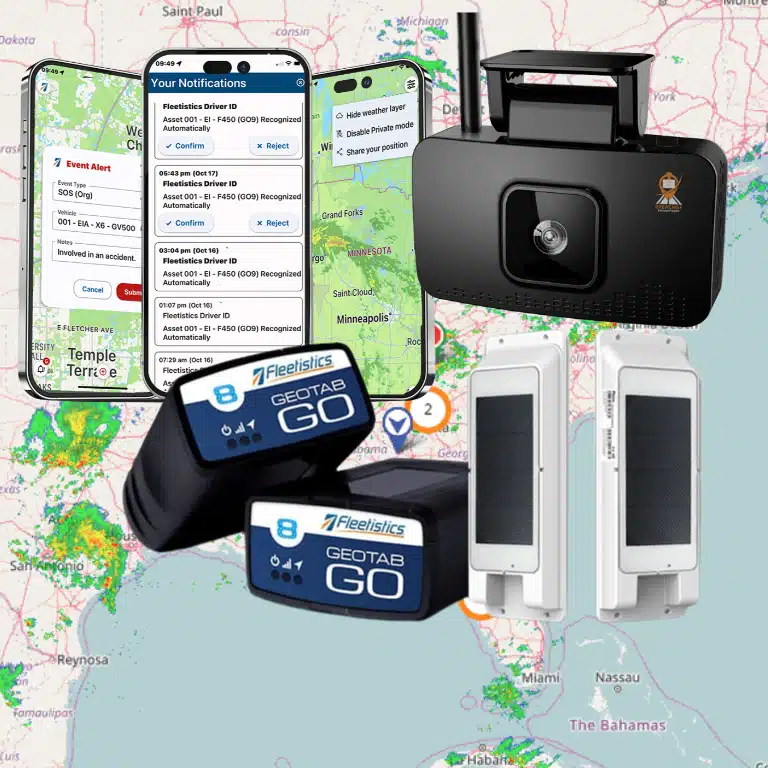

Advanced fleet management is not simply a larger map with more vehicle dots. It is the operating model that helps you turn vehicle, driver, asset, maintenance, route, and business data into decisions with clear owners and repeatable follow-through. That distinction matters as your fleet grows, because more data without better workflows creates more noise, not more control.
A mature program connects diagnostics to maintenance, route conditions to dispatch decisions, safety events to coaching, and APIs to the systems your teams already use. The goal is not to activate every feature. The goal is to know which data deserves attention, which action should follow, and how to measure whether the action improved the operation.
What does advanced fleet management mean when you outgrow location dots?
Basic GPS visibility answers, “Where is the vehicle?” Advanced fleet management helps you answer the next operational questions:
- Is the vehicle healthy enough for the next assignment?
- Is the route realistic for the available time, traffic, and service commitments?
- Which safety events indicate a coaching opportunity rather than a one-time exception?
- Which assets are underused, overdue for service, or creating avoidable cost?
- Who is responsible for responding, by when, and what happens if the issue is not resolved?
At scale, the difference is a closed loop. Data enters the platform, a rule or review identifies a meaningful condition, a person or team receives an assigned action, and the outcome is measured. This is why a mature fleet should evaluate workflows and governance alongside hardware and software features.
Which data should a mature fleet collect and connect?
You do not need every possible signal. You need a reliable set of data that supports the decisions your operation makes every day. Start with five connected data groups.
1. Vehicle and equipment condition
Diagnostics can show engine faults, battery conditions, mileage, utilization, and other indicators that affect availability. The useful question is not whether the platform can display a fault code. It is whether your team can prioritize it, assign it, and keep the vehicle from becoming an unplanned outage.
2. Location, trip, and route context
Location history becomes more valuable when it is connected to planned routes, job sites, dwell time, service windows, and customer commitments. This context helps you distinguish a necessary stop from a process problem and a realistic route from one that routinely creates late arrivals.
3. Driver and safety signals
Speeding, harsh events, following distance, seatbelt behavior, camera events, and coaching records can support a consistent safety program. Use the data to identify patterns, give employees clear expectations, and document fair follow-up. A mature safety workflow is transparent and focused on behavior improvement, not surveillance for its own sake.
4. Maintenance, fuel, and cost data
Maintenance schedules, work orders, fuel activity, idle time, and utilization should be reviewed together. A vehicle that appears inexpensive on a fuel report may be consuming capacity through downtime. While an asset with low mileage may still create cost if it is not assigned effectively.
5. Business and system data
Dispatch, payroll, job management, fuel cards, maintenance systems, customer records, and finance tools add the business context that telematics alone cannot provide. Use fuel cards to connect fuel activity with fleet management, and review Fleetistics platform options as a starting point for assessing which capabilities and integrations fit your current operating model.

How do you turn fleet data into repeatable workflows?
A dashboard is an observation tool. A workflow is a management process. To move from one to the other, define five elements for every high-value signal:
- Trigger: What event or threshold starts the process?
- Context: What additional information prevents a false alarm or poor decision?
- Owner: Which person or team is accountable for the next action?
- Deadline: How quickly does the action need to happen?
- Outcome: What result proves the issue was resolved or the opportunity was captured?
For example, a diagnostic event should not become an unread notification in a shared inbox. It can trigger a review that considers severity, vehicle assignment, warranty status, and the next scheduled route. The maintenance team can then create a work order, place the vehicle in a service queue, or document why the event does not require immediate action.
The same structure applies to route exceptions, safety events, excessive idling, missed inspections, and overdue assets. If an alert does not have an owner or a decision path, it is not yet an operational workflow. It is only another piece of data.
What does a practical fleet maturity framework look like?
Use the following framework to identify your current operating level. You can be advanced in one area and still developing in another. The purpose is to prioritize the next capability that will improve decisions, not to earn a label.
| Stage | Operating pattern | Next development step |
|---|---|---|
| 1. Visibility | You can locate vehicles and review basic history, but teams still rely on calls, spreadsheets, or memory for follow-up. | Establish a consistent data rhythm and choose a small set of operational KPIs. |
| 2. Control | Alerts, inspections, maintenance, and safety reviews have defined owners and documented response steps. | Reduce manual handoffs and measure whether the response happens on time. |
| 3. Optimization | Managers use trends in utilization, route performance, downtime, fuel, and safety to change operating decisions. | Connect business systems and use shared data for planning, budgeting, and accountability. |
| 4. Orchestration | Data moves across systems, workflows are automated where appropriate, permissions are governed, and leaders manage by exception. | Continuously improve the operating model with controlled experiments and outcome reviews. |
Moving up a stage does not require a single large rollout. Select one high-cost or high-risk workflow, establish a baseline, and improve it with the data already available. Then expand the pattern to the next process.
Talk with a fleet management consultant about your next maturity step
Which workflows deserve priority as your fleet grows?
Growing fleets usually gain more from a few well-designed workflows than from a long list of disconnected features. Prioritize processes that affect availability, safety, customer commitments, or cost.
Diagnostics and preventive maintenance
Combine diagnostic data with mileage, engine hours, service history, vehicle type, and assignment priority. The result should help you decide what needs attention now, what can wait, and what should be scheduled before it becomes a roadside or job-site problem. A related predictive fleet maintenance framework can help your team distinguish preventive work from reactive repair.
Route and dispatch optimization
Route optimization is not only a map exercise. Review the relationship between planned routes, actual travel, dwell time, service windows, driver hours, vehicle capacity, and customer commitments. Use exceptions to improve planning rules instead of treating every late arrival as an individual performance failure.
Safety review and coaching
Define which events require immediate review, which patterns belong in a coaching conversation, and how employees can understand the program. Keep the process consistent across locations and supervisors. Use appropriate notice, governance, and buy-in so that safety data supports a fair program.
Utilization and asset decisions
Compare asset availability, utilization, location, operating cost, and work demand. This can reveal underused equipment, duplicated capacity, or assignments that create avoidable travel. The decision may be to redeploy, schedule differently, maintain, replace, or retire an asset. The platform should inform that decision without pretending the data alone can make it.
Compliance and inspection follow-through
For fleets subject to transportation regulations, compliance data should be connected to the people and processes responsible for inspections, duty status, records, and escalation. Use the FMCSA Hours of Service guidance as the authoritative reference for applicable HOS requirements, then configure your internal workflow around your actual fleet and regulatory scope.
How should you evaluate APIs, integrations, and permissions?
Advanced fleet management becomes difficult when the platform creates another isolated data store. During evaluation, ask how data enters and leaves the system, how often it updates, what events can trigger an action, and how errors are identified.
- API fit: Can your team access the records and events it needs without building fragile workarounds?
- Integration depth: Does the connection support the workflow, or does it only copy a static report?
- Data ownership: Can you export and use your data in the systems that run your business?
- Reliability: Are failures, delayed updates, duplicate events, and rejected records visible to an owner?
- Permission design: Can local supervisors see what they need without giving every user access to sensitive fleet or employee data?
- Change management: Can administrators add a location, role, integration, or workflow without rebuilding the entire program?
Fleetistics positions its platform around free APIs and 300+ integrations, with modular options for different fleet sizes and operating models. That open approach is most valuable when you use it to remove a real handoff. Such as sending a maintenance status to dispatch or bringing route completion data into a business system.
Permissions deserve the same attention as integrations. Establish role groups for executives, fleet managers, dispatchers, maintenance teams, supervisors, and drivers. Review access as responsibilities change, and retain an audit trail for material changes. Scalable access is not maximum access. It is the right visibility for each job.
How can you measure whether advanced fleet management is working?
Start with a baseline that connects a business outcome to an operational behavior. Useful measures can include:
- Unplanned downtime hours and repeat repair events
- Preventive maintenance completion rate and overdue work orders
- Planned versus actual route time, distance, and dwell time
- Fuel use per mile, idle time, or fuel exceptions by vehicle and route
- Safety event frequency, coaching completion, and repeat-event rate
- Asset utilization, availability, and cost per operating hour
- Alert-to-action time and the percentage of workflows closed on time
Avoid measuring only logins, alert counts, or the number of reports created. Those figures show activity, not necessarily improvement. A better review asks what changed after the team acted and whether the result lasted across locations, vehicle types, and supervisors.
Fleetistics has served fleets since 2001 and supports a consultative evaluation process. Its published proof points include 24/7 support, an open integration approach, and documented fuel savings associated with the City of Seattle’s 4,100-vehicle fleet. Use evidence such as this to start a conversation, then ask how the same measurement discipline would apply to your fleet’s baseline and operating constraints.
What should you ask before choosing an advanced fleet management platform?
Bring a specific operating problem to the evaluation rather than a generic feature checklist. Ask the provider to demonstrate:
- How a real diagnostic or safety event becomes an assigned action.
- How maintenance, dispatch, route, and business data connect in one review.
- How local teams and enterprise leaders receive different views of the same governed data.
- How APIs, webhooks, exports, and integrations support your existing systems.
- How the platform scales when you add vehicles, locations, users, or asset types.
- How implementation, training, support, and ongoing optimization are handled.
- How success is measured during a time-bounded evaluation.
A provider should be willing to discuss tradeoffs. You may need different devices for different assets, a phased rollout instead of a single launch, or a combination of native features and integrations. The strongest solution is the one your team can operate consistently and improve over time.
Request a fleet management evaluation built around your data and workflows
Frequently Asked Questions
What is the difference between fleet tracking and advanced fleet management?
Fleet tracking primarily provides location and trip visibility. Advanced fleet management connects that visibility with diagnostics, maintenance, safety, routing, analytics, integrations, and permissions so the right person can act on the information.
Does advanced fleet management require an enterprise-size fleet?
No. The operating model can be scaled to a small, mid-size, or enterprise fleet. Smaller teams may start with one workflow, such as maintenance or route review, while larger fleets may need integrations, role-based access, and cross-location governance from the beginning.
What data should a fleet connect first?
Start with data tied to a measurable problem. For many fleets, that means vehicle condition, maintenance history, route performance, safety events, utilization, and fuel activity. Add business-system data when a manual handoff is slowing decisions or creating duplicate work.
How long does it take to evaluate a fleet management platform?
Use a defined evaluation period with a baseline, selected workflows, owners, training, and success measures. Fleetistics commonly frames its standard Solution Evaluation Process around 60 days, while the right timeline depends on fleet size, implementation scope, and the workflows you need to validate.
How does Fleetistics support growing and enterprise fleets?
Fleetistics combines modular fleet management options with Geotab reseller experience, free APIs, 300+ integrations, and 24/7 support. A consultation can help match the platform, hardware, data connections, and workflow design to your fleet’s size and operating model.
How can you start building a more mature fleet operation?
Choose one workflow where better data and faster follow-through can produce a visible operational gain. Define the trigger, context, owner, deadline, and outcome, then measure the baseline before expanding. That disciplined approach helps you move from location visibility to a fleet operating model that scales.
Speak with Fleetistics about a 60-day Solution Evaluation Process.