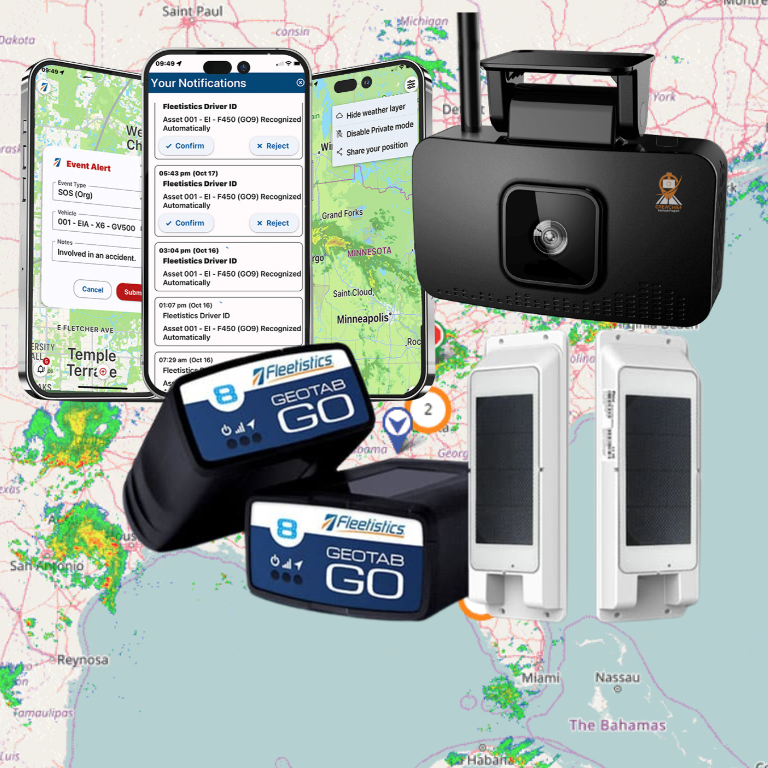
Motor fleet management is the coordinated process of tracking, maintaining, protecting, and improving a business fleet of cars, vans, trucks, and specialty vehicles. The goal is not simply to see where vehicles are. It is to turn reliable vehicle data into safer decisions, fewer avoidable costs, stronger uptime, and clear accountability.
What is motor fleet management?
Motor fleet management brings vehicle assignment, GPS tracking, maintenance, driver safety, fuel use, compliance records, and utilization into one operating framework. A small service company may use it to confirm that crews reach every job and that vehicles receive preventive maintenance. A larger organization may need shared visibility across departments, facilities, regions, or a central motor pool.
The practical difference between basic tracking and effective management is the workflow around the data. A map can show a vehicle’s current position, but a management system can also help a fleet team identify overdue service, respond to unsafe driving, document inspections, compare planned and actual routes, and act before a small issue becomes downtime or a claim.
Motor fleet management can support mixed fleets, including passenger vehicles, service vans, pickup trucks, vocational vehicles, trailers, and equipment. The right scope depends on how the vehicles are used, who operates them, what regulations apply, and which decisions the business needs to make every day.
Which vehicle visibility data should you manage?
Visibility should answer operational questions, not create a larger pile of reports. Start by defining what the fleet manager, dispatcher, safety leader, maintenance coordinator, and business owner each need to know.
- Where is each vehicle? Live location and recent trip history help teams respond to customer questions, coordinate dispatch, and investigate exceptions.
- How is each vehicle being used? Mileage, engine hours, idle time, stops, dwell time, and route patterns show whether assets are available and productive.
- Who is driving? Driver identification and assignment records connect events to the right operator while supporting fair, consistent coaching.
- What is happening now? Configurable alerts can surface unauthorized movement, excessive idling, harsh driving, geofence events, or diagnostic warnings.
- What changed over time? Historical data helps compare routes, utilization, fuel behavior, safety events, maintenance timing, and asset availability.
For vehicle-location fundamentals, see automatic vehicle location and AVL GPS tracking. For hardware selection, review GPS tracking hardware based on the vehicle, installation environment, power needs, and data requirements.
Visibility also needs governance. Tell drivers and employees what information is collected, why it is collected, who can access it, and how long it is retained. A written employee introduction to GPS tracking can help leaders explain the program as a safety and service process rather than a hidden surveillance exercise.
How do you turn tracking data into a maintenance workflow?
Maintenance is where visibility becomes a direct uptime strategy. A useful program combines scheduled service with condition-based signals, clear ownership, and a documented closeout process. Tracking mileage or engine hours alone does not repair a vehicle. The fleet needs a workflow that moves from signal to work order to verification.
- Build a complete asset record. Record the vehicle identification, class, department, location, service interval, warranty details, and the meter used for scheduling. Do the same for trailers or equipment that require separate inspections.
- Set preventive-maintenance rules. Use mileage, engine hours, calendar dates, or a combination of these measures. Match intervals to the manufacturer’s requirements, operating conditions, and the vehicle’s actual use.
- Capture diagnostic and inspection signals. Engine faults, battery issues, excessive idle time, inspection findings, and driver-reported defects can help prioritize attention. Treat a diagnostic code as a reason to investigate, not as a substitute for a qualified technician’s assessment.
- Assign and schedule the work. Every open issue should have an owner, a priority, a due date, and a clear status. Critical safety defects need a different response from a cosmetic repair or a low-priority improvement.
- Close the loop. Record what was repaired, when the vehicle returned to service, and whether a follow-up check is required. A closed work order without a return-to-service decision leaves availability uncertain.
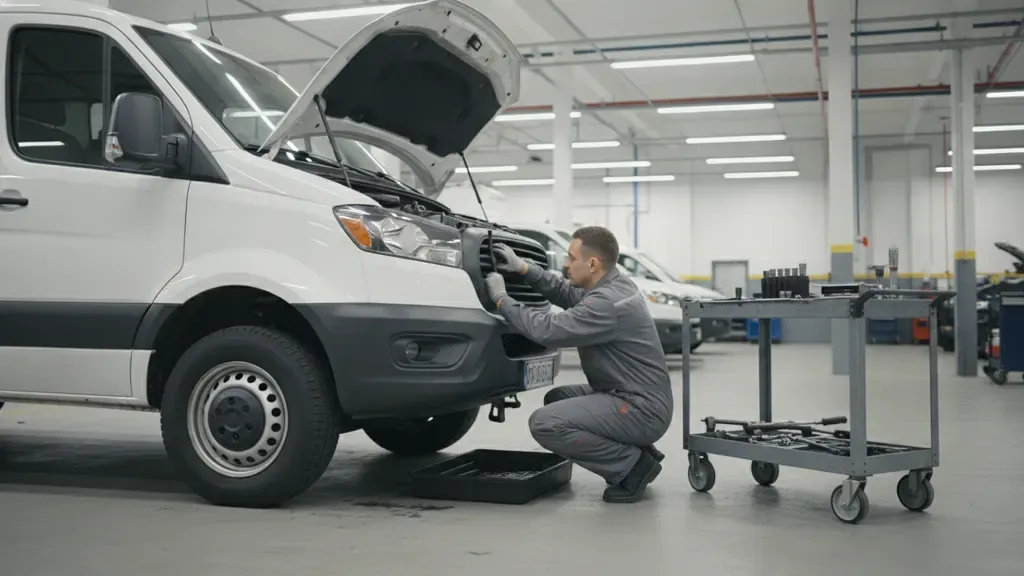
Fleet teams can connect location and telematics information with maintenance processes through a fleet maintenance program. The value is not that every repair becomes predictive. The value is that managers can identify patterns earlier, keep records together, and make vehicle availability visible to the people planning work.
How can motor fleet management improve driver safety?
Safety management works best when it combines clear expectations, timely coaching, and evidence-based follow-up. A telematics platform can identify behaviors such as speeding, harsh braking, rapid acceleration, cornering, seatbelt exceptions, or extended idling, depending on the device and configuration. The fleet should decide which events matter most instead of sending every possible alert to every manager.
Use a graduated response. A single low-risk event may warrant a conversation or a reminder. A repeated pattern can trigger coaching, a ride-along, route review, or additional training. A serious event should follow the organization’s incident process and preserve the relevant records. Managers should measure whether coaching changes behavior, not just how many alerts a system generates.
Video telematics can add context when a collision, near miss, or disputed event occurs. Fleetistics’ AI dashcam solutions can be evaluated alongside GPS and vehicle data when a business needs a more complete safety picture. The selection decision should consider camera placement, privacy expectations, event review, retention, driver communication, and who is authorized to access footage.
Employee buy-in is part of the safety system. Publish a driver policy, explain the purpose of monitoring, define how data is used, and provide a consistent appeal or review process. Fleetistics provides a sample driver policy for GPS tracking and a company driving policy that can help a business build its own rules. Policies should be reviewed for local employment, privacy, and labor requirements before adoption.
Contact Fleetistics to discuss a motor fleet safety and visibility program
Which compliance workflows belong in the system?
Compliance is not one universal checklist. The correct workflow depends on vehicle type, operating territory, driver role, and the work the vehicle performs. A local service fleet, a municipal motor pool, and an interstate carrier may all use motor vehicles, but they do not have identical obligations.
For fleets that fall under applicable commercial motor-carrier rules, an integrated system can help organize electronic logging, driver vehicle inspection reporting, records, exceptions, and fuel-tax information. Fleet teams should confirm requirements with the applicable regulator and their compliance adviser. The FMCSA hours-of-service guidance is an authoritative starting point for U.S. hours-of-service questions.
Do not assume every local or short-haul fleet needs an ELD. ELD-related workflows are relevant when the fleet’s operations and regulatory status make them applicable. A strong motor fleet management program can still support inspection records, maintenance documentation, driver qualification processes, incident records, and policy acknowledgments for vehicles that do not need an ELD.
For a broader overview of compliance tools, review Fleetistics’ fleet compliance resources. The system should make missing records visible, establish escalation rules, and show who resolved an exception. It should not encourage managers to treat a green dashboard as proof that every legal requirement has been met.
How should you create a daily motor fleet control process?
A management platform creates value when the team uses it in a repeatable cadence. Keep the routine simple enough that managers can follow it even during a busy operating day.
Start of day: confirm readiness
- Review vehicles that are out of service, overdue for inspection, or assigned to open work orders.
- Confirm that scheduled vehicles, drivers, and routes are aligned.
- Check for critical diagnostic, safety, unauthorized movement, or geofence alerts.
- Resolve exceptions that could prevent a vehicle from completing its planned work.
During the day: manage exceptions
- Use live location and route information to answer operational questions quickly.
- Escalate safety events according to the written driver and incident policies.
- Document changes to vehicle assignments, substitutions, delays, and service interruptions.
- Use alerts selectively so the team focuses on decisions rather than noise.
End of day: capture what the data taught you
- Review missed stops, unusual dwell time, excessive idle, and unauthorized use.
- Record driver or vehicle issues that require follow-up the next day.
- Compare completed work with planned work and identify recurring constraints.
- Confirm that serious events have an owner and a documented next step.
Once the daily routine is stable, add a weekly review for maintenance backlog, vehicle utilization, safety trends, fuel behavior, and unresolved compliance exceptions. A monthly review should connect those trends to business outcomes such as asset availability, overtime, customer response time, preventable incidents, and replacement planning.
Which KPIs show whether the fleet is under control?
Choose a small set of measures that lead to action. A dashboard with dozens of metrics can hide the few signals that determine whether the fleet is safe, available, and productive.
| Control area | Useful KPI | Management question |
|---|---|---|
| Availability | Vehicle uptime and out-of-service days. | Can operations assign the vehicles they need? |
| Maintenance | Preventive work completed on time and repeat repairs. | Are we preventing avoidable downtime? |
| Utilization | Miles, engine hours, trips, idle time, and asset use by unit. | Are vehicles right-sized and used for the work assigned? |
| Safety | Events per mile, coaching completion, and repeat event rate. | Is driver coaching changing behavior? |
| Compliance | Open exceptions, inspection completion, and record timeliness. | Can we produce the required records when needed? |
| Service | On-time arrival, completed stops, and customer issue resolution. | Does vehicle control improve the customer experience? |
Set a baseline before changing policies or buying new hardware. Then assign each KPI an owner and a review frequency. If a metric does not lead to a decision, remove it or move it to a lower-level report.
How do you choose a motor fleet management platform?
Start with the operating problems, not a feature checklist. Ask which decisions are currently delayed by missing information, which records are kept manually, and which teams need the same data. Then test whether a platform can support those workflows without forcing every fleet into the same configuration.
- Vehicle and asset fit: Can the hardware support the vehicle classes, power requirements, environmental conditions, and installation approach in your fleet?
- Workflow fit: Can location, maintenance, safety, inspections, alerts, and reporting connect in a way your team will actually use?
- Scalability: Can you start with one operating group and expand without rebuilding the data structure?
- Integration: Can the platform exchange data with dispatch, maintenance, payroll, fuel, insurance, or other systems through available integrations or APIs?
- Governance: Can you set roles, permissions, retention rules, driver notices, and review procedures appropriate to the organization?
- Support and implementation: Who will configure the system, train managers and drivers, validate the first workflows, and help the team measure ROI?
Fleetistics approaches fleet management as a modular platform rather than a one-size-fits-all package. Its Geotab partnership, vehicle and asset tracking, safety tools, maintenance capabilities, compliance options, open APIs, and 300-plus integrations can support different operating models. Fleetistics has served fleets since 2001 and provides 24/7 support, but the right configuration still depends on the fleet’s vehicles, use cases, regulatory requirements, and internal ownership.
Use the fleet management platform comparison to organize the evaluation around actual needs. A consultative fleet management assessment can help identify which data, hardware, workflows, and integrations belong in the first phase.
Book a Demo to map your fleet visibility and control priorities
Frequently asked questions about motor fleet management
What is the main purpose of motor fleet management?
The main purpose is to give a business the visibility and workflows it needs to operate vehicles safely, reliably, and efficiently. It connects tracking, maintenance, driver safety, compliance, utilization, and reporting so managers can act on exceptions instead of relying on disconnected spreadsheets and phone calls.
What is the difference between GPS tracking and motor fleet management?
GPS tracking primarily answers where a vehicle is and where it has been. Motor fleet management uses that information with maintenance, safety, compliance, assignment, and performance workflows to improve decisions across the vehicle lifecycle.
Can small businesses use motor fleet management?
Yes. A small business can begin with a focused workflow such as vehicle location, maintenance reminders, driver accountability, or customer arrival visibility. The platform and hardware should be scaled to the fleet’s size, vehicle types, operating risks, and goals rather than purchased as an oversized package.
Does every motor fleet need an ELD?
No. ELD requirements depend on the fleet’s operations, vehicle use, and applicable regulations. Fleets should confirm their status with qualified compliance advisers and use ELD tools when the rules apply, while maintaining the other safety, inspection, maintenance, and policy workflows their operations require.
Build control around the decisions your fleet makes
Motor fleet management works when data reaches the people who can act on it. Begin with a clear inventory, a small set of operating priorities, and written ownership for maintenance, safety, compliance, and exceptions. Then configure the platform around the fleet you actually run, measure the results, and expand the workflow as the organization learns.
Contact Us Today to evaluate a motor fleet management solution