
Managing five to 50 vehicles is large enough for missed maintenance, inefficient routes, and unclear driver activity to affect your margins. But not so large that you need an enterprise system built for hundreds of units. The right GPS platform should give you dependable visibility first, then add useful tools as your operation matures.
For a small business fleet, gps tracking for small business fleet means using connected vehicle data to see locations, coordinate dispatch, monitor utilization, plan maintenance, and identify avoidable operating costs. Start by matching the system to your daily decisions, fleet type, and growth plans rather than buying the longest feature list.
Talk with Fleetistics about the right-sized solution for your fleet.
That approach also makes implementation easier. You can establish a baseline for idle time, route miles, utilization, maintenance activity, and administrative work, then measure whether the technology improves those specific outcomes. The first step is understanding what GPS tracking actually does in day-to-day fleet operations and which capabilities deserve priority.
What Does GPS Tracking for a Small Business Fleet Actually Do?
GPS tracking connects each vehicle to a secure platform that shows where it is, where it has been, and how it is being used. A small business fleet can use that information to answer practical questions: Which driver is closest to the next job? Did a vehicle take an efficient route? Is equipment sitting unused, idling, or due for service?
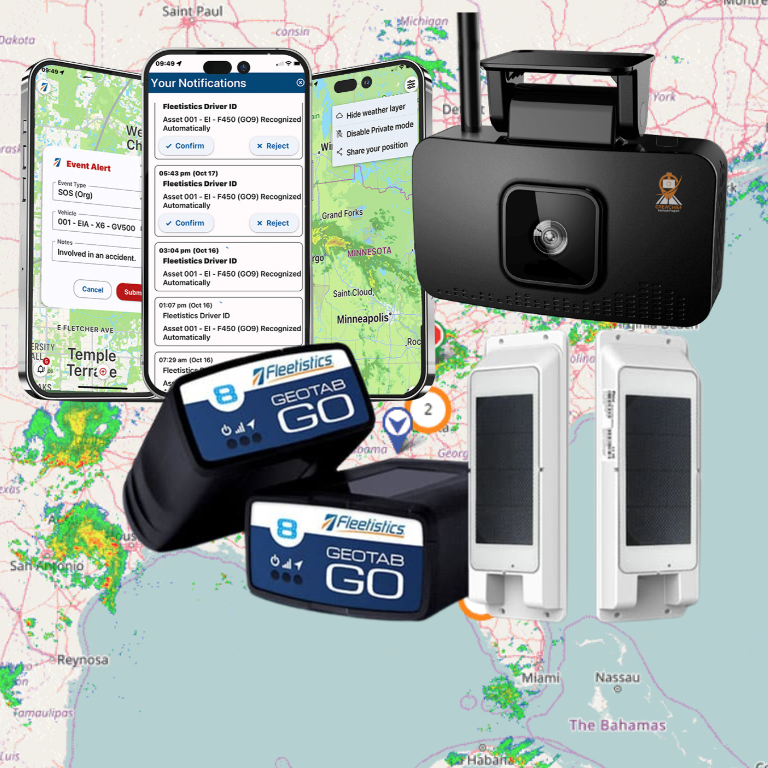
At its simplest, the system is a location tool. A telematics device sends vehicle-position data to a dashboard, where an owner, dispatcher, or fleet manager can view the fleet on a map. That is the foundation of an automatic vehicle locator, but the operational value extends beyond seeing a moving dot.
How does GPS tracking improve daily visibility?
Live location data gives dispatchers a clearer view of the workday. They can provide more accurate arrival updates, assign nearby vehicles, and respond when a job changes. With the right connected tools, dispatchers can also update drivers about traffic or detours in real time, helping the business use its existing vehicles more effectively. The U.S. Department of Transportation describes these routing and communication capabilities as part of the efficiency value of fleet management technology: read the DOT transportation technology case study.
What can a small fleet learn about drivers and vehicles?
GPS tracking can identify patterns in speeding, harsh driving, excessive idling, and unauthorized vehicle use when the selected hardware and software support those measures. That gives you a basis for coaching and setting consistent expectations, rather than relying on isolated complaints or incomplete driver reports. The DOT notes that drivers who know their behavior is monitored tend to follow company and regulatory standards, which can reduce accidents and vehicle or freight damage.
Vehicle data can also support maintenance planning. Diagnostic alerts and service records help you address issues before a vehicle reaches a failure point. Schedule work around customer commitments, and reduce the administrative burden of keeping separate logs. You can then compare maintenance needs with mileage, utilization, and operating patterns instead of treating every vehicle identically.
Is GPS tracking mainly a safety tool?
No. It supports safety, but it should be part of a broader motor-vehicle safety program that includes policies, training, and accountability. The CDC’s National Institute for Occupational Safety and Health outlines these broader program components for employers: review the NIOSH motor-vehicle safety guidance.
For a fleet of five to 50 vehicles, the right approach is usually modular. Start with visibility, dispatch, and maintenance needs you can act on now. Add routing analytics, driver-behavior tools, or safety equipment as your workflows and fleet grow, rather than paying for complexity your team will not use.
What Should Small Fleets Measure Before Buying GPS Tracking?
Start with your own operating baseline. A tracking platform is most useful when it helps you compare everyday performance before and after implementation, rather than when it simply produces a map of vehicle locations. For a fleet of 5 to 50 vehicles, choose a small set of measures that connect directly to fuel, capacity, maintenance, customer service, and manager time.
Use the same date range for each measure, such as four weeks during a normal operating period. Record the fleet size and any unusual conditions, including seasonal demand, major vehicle downtime, or route changes. Then ask prospective providers how their system will collect and report the information you actually need.
- Record idle time. Capture total idle hours, average idle time per vehicle, and which vehicles or routes account for the most idling. The Federal Highway Administration notes that telematics can support idle-time reduction and fuel-efficiency improvements, but your baseline should establish your fleet’s current pattern before you estimate any opportunity. Review the federal telematics research for context.
- Measure route miles and travel time. Track total miles, out-of-route miles where available, average drive time between stops, and late arrivals or missed appointments. Separate unavoidable travel from preventable backtracking. This gives you a practical way to evaluate routing, dispatch visibility, and customer update workflows without assuming a guaranteed savings amount.
- Calculate utilization. For each vehicle, note available work hours, assigned work hours, completed jobs, and days out of service. Low utilization may indicate weak scheduling, excess capacity, or a vehicle that is unavailable when demand exists. High utilization with frequent delays may point to a need for better dispatch coordination or additional capacity.
- Count maintenance events and downtime. Review preventive services, diagnostic alerts, unscheduled repairs, roadside events, and days each vehicle was unavailable. Connected diagnostics can support proactive maintenance planning before failure, but compare the system’s alerts with your existing records so you can judge accuracy and follow-through.
- Time administrative work. Estimate weekly hours spent calling drivers for location updates, reconstructing routes, compiling mileage, answering customer status questions, and maintaining manual logs. Include the people involved, not just the fleet manager. A solution should reduce repetitive work while giving authorized staff usable information.
- Set a review method. Put your baseline in a simple spreadsheet and define the reports, users, and time period you will review after launch. A fleet analytics software platform can help turn these measures into trends and comparisons. Ask for a demonstration using your actual goals, then reassess the same measures throughout the 30-day evaluation period instead of relying on a vague impression.
Your baseline will also show which features deserve priority. If administrative time is the main constraint, reporting and permissions may matter more than advanced safety tools. If downtime is costly, diagnostics and maintenance workflows should lead the evaluation. This approach keeps GPS tracking for small business fleet decisions grounded in your operation, not in a generic feature checklist.
DIY vs Professional GPS Tracking: Which Model Fits 5 to 50 Vehicles?
DIY GPS trackers can be appealing when you need a quick location check and have time to manage the system yourself. A professional platform is different: it combines hardware, software, implementation guidance, reporting, and ongoing support into an operating system for the fleet. The better choice depends less on vehicle count alone than on how much coordination your operation requires.
For a few vehicles with straightforward routes, one decision-maker, and limited reporting needs, a basic tracker may cover the essentials. As vehicles, drivers, customers, service areas, and maintenance responsibilities multiply, the cost of managing disconnected tools often becomes the larger concern. A supported platform can make ownership clearer and help you act on information instead of simply viewing dots on a map.
DIY trackers compared with a professional fleet tracking platform
| Criterion | DIY tracker or app | Professional supported platform |
|---|---|---|
| Setup | You select devices, install them, configure alerts, and troubleshoot issues internally. | A specialist helps match devices and workflows to your vehicles, then supports rollout and adoption. |
| Data and reporting | Usually centered on location, with reporting depth dependent on the product and your configuration. | Combines location with operational reporting such as utilization, routing, driver behavior, and maintenance planning. |
| Scalability | May work well initially, but adding vehicles, users, rules, and workflows can increase manual administration. | Designed to expand from simple tracking into analytics, routing, safety, and other capabilities as needs develop. |
| Support | Your team owns device questions, user training, data interpretation, and process changes. | You have an implementation partner to help configure the system, train users, and resolve operational questions. |
| Integrations | Connections may be limited or require separate tools and manual exports. | Open APIs and integrations can connect tracking data with the systems your business already uses. |
| Accountability | It is easy for alerts and reports to become nobody’s assigned responsibility. | Defined users, permissions, alerts, and review routines make ownership easier to establish. |
Choose DIY when your workflow is genuinely simple and someone has the time and skill to maintain it. Choose professional gps tracking for small business fleet operations when missed maintenance, inefficient routing, customer updates, or inconsistent driver oversight can affect revenue or service quality. For a 5-vehicle fleet, start with the smallest useful capability. For a 50-vehicle fleet, evaluate administration, integrations, and accountability as carefully as the tracking hardware.
A modular provider can support both starting points. Fleetistics offers tiers for fleets beginning at five vehicles, allowing you to add capabilities as operating complexity grows rather than replacing the entire system at the next stage.
Which GPS Tracking Features Matter Most for 5 to 50 Vehicles?
For a smaller fleet, the best system is not the one with the longest feature list. It is the one that helps you answer operational questions quickly, gives the right people useful access, and can expand as your business changes. Use this checklist to separate core capabilities from tools you may add later.
Live location and geofences
Start with dependable, near-real-time vehicle location. You should be able to see where each vehicle is, review recent trips, and give customers a more accurate arrival update without calling drivers repeatedly. Geofences add context by notifying you when a vehicle enters or leaves a job site, depot, service area, or other defined location. Look for clear map views and useful alerts, not a dashboard that requires technical training to interpret.
Maintenance and vehicle diagnostics
Tracking mileage alone is helpful, but connected diagnostics can make maintenance planning more proactive. The U.S. Department of Transportation describes how vehicle diagnostics and schedule alerts can help managers address issues before a vehicle reaches the point of failure: read the transportation technology brief. Prioritize reminders, fault-code visibility where supported, service history, and an easy way to assign follow-up work.
Routing, dispatch, and driver communication
A useful platform should support the work between the office and the road. Dispatchers may need to adjust a route for traffic, a detour, an urgent service call, or a changed appointment. Choose tools that let authorized staff communicate updates and help drivers find the next stop without creating unnecessary calls and paperwork. A mobile fleet management app can be especially valuable when owners, supervisors, and technicians need access away from a desk.
Driver behavior and safety
Depending on your vehicles and policy, useful behavior data may include speeding, harsh braking, rapid acceleration, or excessive idling. The goal is coaching and risk reduction, not collecting data without a plan. The DOT notes that monitoring can encourage drivers to follow company and regulatory standards, while NIOSH recommends a structured motor-vehicle safety program. If video evidence is part of that program, evaluate commercial fleet camera systems alongside GPS tracking.
Permissions, integrations, and room to grow
As your fleet approaches 50 vehicles, access controls matter. You may want an owner to see everything, a dispatcher to manage routes, and a supervisor to review only an assigned group. Confirm that the system supports role-based permissions and usable reports. Also check for integrations with your existing operations software. Fleetistics states that its platform offers free API access and more than 300 marketplace integrations, which can help reduce data silos. A modular solution lets you begin with tracking and add analytics, routing, maintenance, or safety capabilities when the workflow justifies them.
How Does Fleetistics Serve Small Fleets Without Enterprise Bloat?
Small fleets do not need a stripped-down system that becomes limiting as soon as the business grows. They need a practical starting point, clear implementation guidance, and the option to add capabilities when the operation can use them. Fleetistics supports gps tracking for small business fleet programs by combining a modular platform with hands-on consultation.
Five ways to start with the right level of capability
Fleetistics offers five solution tiers: MAP, LITE, ONE, GO, and BY IoT. The structure is designed for fleets starting at five vehicles, so an owner does not have to adopt an enterprise-scale deployment before the operation is ready. You can begin with the tracking and visibility your team needs now, then evaluate whether analytics, routing, safety, or other tools make sense as the fleet changes.
That approach matters because fleet complexity does not always grow in a straight line. A five-vehicle service business may need location visibility and maintenance organization first. Later, increased dispatch volume or more drivers may justify deeper reporting, driver-behavior monitoring, or workflow integrations. Modular growth lets you solve the current operational problem without buying capabilities that will sit unused.
An advocate and implementation partner, not just a hardware provider
Fleetistics is a Geotab partner and helps customers select and configure an appropriate solution for their operation. The role is consultative: Fleetistics advocates for your business, supports implementation, and can involve Geotab technical or development resources when needed. Customers work with Fleetistics as their implementation partner rather than being left to navigate a complex platform alone.
The platform also has an open ecosystem, with free API access and more than 300 marketplace integrations. That gives a small business room to connect fleet data with the systems it already relies on, instead of creating another isolated dashboard. Before choosing an integration, identify the manual handoff you want to eliminate and confirm that the connection supports that workflow.
Evaluate the fit before making a long-term decision
Fleetistics offers a 30-day Solution Evaluation Process to help a business assess fit before committing to a long-term fleet-management approach. Use that period to define what success means for your fleet, establish a baseline for dispatch or maintenance work. And review whether the system is producing information your team can act on. The goal is not to collect more data. It is to make better operating decisions with a solution that can grow at the pace of your business.
What Does a Practical 10-Vehicle Rollout Look Like?
A successful rollout starts with a short list of operational decisions, not a device installation appointment. Identify the problems your team needs to see more clearly, such as missed arrival windows. Excessive idle time, uncertain vehicle use, maintenance gaps, or too much time spent answering location calls. These priorities determine which tracking, reporting, routing, and safety capabilities belong in the first phase.
Start with the fleet and the people using it
Review the ten vehicles by role, age, operating area, and daily workflow. A service van that visits scheduled jobs may need different alerts than a truck moving between multiple sites. Confirm hardware compatibility, installation requirements, and whether the system can capture the vehicle data you actually need. Then define who will use the platform: an owner, dispatcher, operations manager, maintenance lead, or supervisor. Give each person the minimum permissions required for the job. Drivers may need mobile instructions or updates, while broader reporting access should remain with the people responsible for fleet decisions.
For day-to-day coordination, a mobile fleet management app can help authorized staff stay connected when they are away from a desktop. Keep the first configuration focused. Live location, basic geofences, trip history, and a small number of useful notifications are easier to adopt than an overcrowded alert list.
Capture a baseline before changing behavior
Before asking the team to improve performance, record a practical baseline. Depending on your goals, that may include typical idle time, route miles, unauthorized use, dispatch interruptions, missed maintenance activities, or average response time to location requests. The baseline does not need to be perfect. It needs to be consistent enough to compare the first few weeks with the starting point.
Training should use your real routes and common situations. Show managers how to find a vehicle, review a trip, acknowledge an alert, and export or share a report. Show drivers what information is collected, which behaviors are being addressed, and how location data supports dispatch and safety. Written expectations matter as much as technical instruction.
Review the first week, then expand deliberately
During the first week, hold a brief review with the people who use the system most. Remove alerts that do not lead to action, correct vehicle or user records, and document questions that recur. Do not judge the rollout by the volume of data. Judge it by whether the information helps someone make a faster, clearer decision.
Expansion triggers should be operational. Add maintenance or diagnostic workflows when service records remain inconsistent. Consider routing or analytics when managers need recurring performance comparisons. Add safety tools when documented risk patterns justify them. A modular platform lets a ten-vehicle business begin with its immediate needs and add capability as the workflow proves its value.
Contact Fleetistics to plan a right-sized fleet tracking rollout.
Frequently Asked Questions
How many vehicles should a small business have before adding GPS tracking?
There is no fixed minimum, but tracking becomes practical when location updates, maintenance records, dispatch, or driver oversight are taking meaningful staff time. A five-vehicle fleet can start with basic visibility and add analytics, routing, or safety tools as its needs grow.
What should I measure to determine whether GPS tracking is paying off?
Record baseline figures for idle time, fuel use, route miles, missed appointments, maintenance delays, vehicle utilization, and administrative hours. Compare those measures after rollout rather than relying on impressions. The U.S. Department of Transportation identifies idling, fuel efficiency, routing, utilization, and maintenance planning as relevant telematics outcomes: DOT telematics research.
Can a GPS tracking system grow with a fleet from 5 to 50 vehicles?
Yes, if you choose a modular platform with clear upgrade paths, user permissions, integrations, and support. Fleetistics offers five tiers, MAP, LITE, ONE, GO, and BY IoT, for fleets starting at five vehicles. So you can begin with core tracking and expand capability as operations become more complex.
How long should a small fleet evaluate a GPS tracking solution?
Use enough time to establish a baseline, train users, test the workflows that matter, and review results across normal operating conditions. Fleetistics offers a 30-day Solution Evaluation Process, which gives a small business a defined period to validate fit before making a longer-term decision.
Ready to Choose the Right GPS Tracking Approach?
A smaller fleet still deserves tools that match its daily workflows, growth plans, and operating priorities. A consultative conversation can help you identify the capabilities worth adopting now and the options you can add later. Request a consultative demo to discuss the right-sized GPS tracking approach for your fleet, or contact the Fleetistics team with your questions.