Selecting the right fleet management platform is one of the most critical operational decisions a fleet manager will make in 2026. A complete fleet management software comparison 2026 is your blueprint for choosing a system that delivers real ROI rather than just an expensive GPS map. This guide analyzes the six platforms mid-market fleets are actually using and breaks down features, pricing, integrations, and real-world results.
Before you evaluate vendors, review our comprehensive Fleet GPS Tracking for Business Complete Buyer Guide to establish your baseline operational goals. That pillar guide covers hardware selection, deployment strategies, and ROI measurement frameworks that apply across every platform in this comparison.
Fleet Management Software Comparison 2026: The 6 Fleet Management Software Platforms Mid-Market Fleets Are Actually Using
The mid-market segment (50 to 500 vehicles) has unique requirements. You need enterprise-grade data depth without the administrative overhead of a DIY platform or rigid multi-year contracts. Here are the six platforms dominating the 2026 landscape:
- Fleetistics (Geotab-Powered) — Best overall for flexibility, value, and integration depth. As the longest-running Geotab distributor in the United States with over 21 years of partnership. Fleetistics combines Geotab’s world-class engine (4.7 million devices deployed globally) with personalized support and zero long-term contracts.
- Samsara — Premium platform focused on AI-powered dashcams and real-time operations. Standard contracts require a rigid 36-month commitment with premium pricing. GPS refresh is time-interval based at 10 to 30 seconds.
- Verizon Connect — Legacy market giant backed by Verizon’s cellular infrastructure. Offers comprehensive features but requires long-term commitments and slower tier-based support. GPS refresh is 30 seconds.
- Motive (formerly KeepTruckin) — Known for strong ELD compliance heritage. They have expanded into AI dashcams, though independent surveys place their customer satisfaction lower than Geotab-powered platforms.
- Teletrac Navman — Reliable mid-market option with solid compliance and asset-tracking tools, though less customizable than open-API platforms.
- Fleetio — Software-only fleet maintenance platform. Rather than competing in tracking, Fleetio integrates with telematics engines like Fleetistics to provide advanced preventive maintenance workflows.
Feature-by-Feature Breakdown: What Each Platform Does and Doesn’t Include
When performing your fleet management software comparison 2026, evaluating standard marketing checklists is not enough. You need to know how these platforms perform under real daily operations. The table below maps core capabilities across the leading systems. Each row focuses on one decision factor for mid-market fleet buyers.
| Feature Category | Fleetistics (Geotab) | Samsara | Verizon Connect | Motive |
|---|---|---|---|---|
| GPS Refresh Rate | Second-by-second curve logging | 10 to 30 seconds | 30 seconds | 1 to 3 seconds |
| API and Developer Access | Free, fully open APIs and SDKs | Premium paid API tiers | Restricted access | Basic open APIs |
| Hardware Warranty | Limited lifetime warranty | 1 to 3 years | 1 year | 1 year |
| Contract Flexibility | Modular tiers with no long-term trap | Rigid 36-month minimum | Rigid 36-month minimum | 12 to 36-month terms |
| AI Dashcam Support | Fully integrated multi-camera | Proprietary Samsara AI camera | Integrated options | Proprietary Motive camera |
GPS Tracking and Real-Time Telematics
Basic GPS systems only show where a vehicle was. Fleetistics utilizes Geotab’s patented curve-logging algorithm, which records data points based on changes in speed and direction rather than fixed time intervals. This delivers accurate second-by-second data without bloating cellular bandwidth.
Samsara and Verizon Connect rely on time-interval pings, which can cut corners on maps and miss critical driving events such as hard braking or rapid acceleration. For fleets that need precise route reconstruction for compliance or accident documentation, curve-logging technology provides a significant advantage.
Compliance Management (ELD, DVIR, IFTA)
Staying compliant with FMCSA regulations across the United States, Canada, and Mexico is a non-negotiable requirement for any commercial fleet. While Motive built its brand on ELD logging, Fleetistics provides a more unified compliance suite that covers all three jurisdictions.
The system automates Hours of Service (HOS) rules for both US and Canadian drivers, electronic Driver Vehicle Inspection Reports (DVIR), and multi-state IFTA fuel tax calculations. These automated workflows keep your drivers legal while reducing the office paperwork burden on your administrative team.
AI and Automation in Fleet Management
Artificial intelligence has become a central differentiator in modern fleet platforms. AI-powered dashcams now detect distracted driving, drowsiness, and unsafe following distances in real time. Fleetistics integrates these capabilities directly with driver coaching and insurance reporting workflows.
Samsara has invested heavily in computer vision for its AI dashcam product line. Motive offers similar capabilities with its proprietary camera hardware. The key difference is that Fleetistics provides flexible multi-camera support across hardware vendors. This means you are not locked into one camera ecosystem if your needs change over time.
Automation also extends to maintenance scheduling. Geotab’s engine diagnostics data can trigger automatic work order creation in integrated systems like Fleetio. This predictive approach catches small mechanical issues before they become expensive roadside breakdowns. For mid-market fleets running tight budgets, preventing even one major repair per quarter can offset the entire annual software cost.
Safety Coaching and AI-Powered Dashcams
Real-time driver coaching protects your brand reputation and reduces insurance liabilities. Fleetistics supports advanced AI dashcams that detect distracted driving, tailgating, phone use while driving, and drowsiness indicators. Immediate in-cab audio alerts help drivers self-correct before an incident occurs.
The dashcam footage integrates directly with driver coaching workflows and insurance claims documentation. When an incident does happen, having video evidence and GPS telemetry data can significantly reduce liability exposure and fraud claims.
Pricing Models: Per-Vehicle vs Flat-Rate vs Usage-Based
Most fleet software providers hide their pricing behind aggressive sales funnels. Look beyond the initial quote and evaluate total cost of ownership over three to five years:
- The Subscription Trap — Providers like Samsara and Verizon Connect bundle hardware and software into high monthly fees (typically $25 to $45+ per vehicle) but lock you into rigid 36-month contracts. If your business downsizes, you are still bound to pay for unused lines.
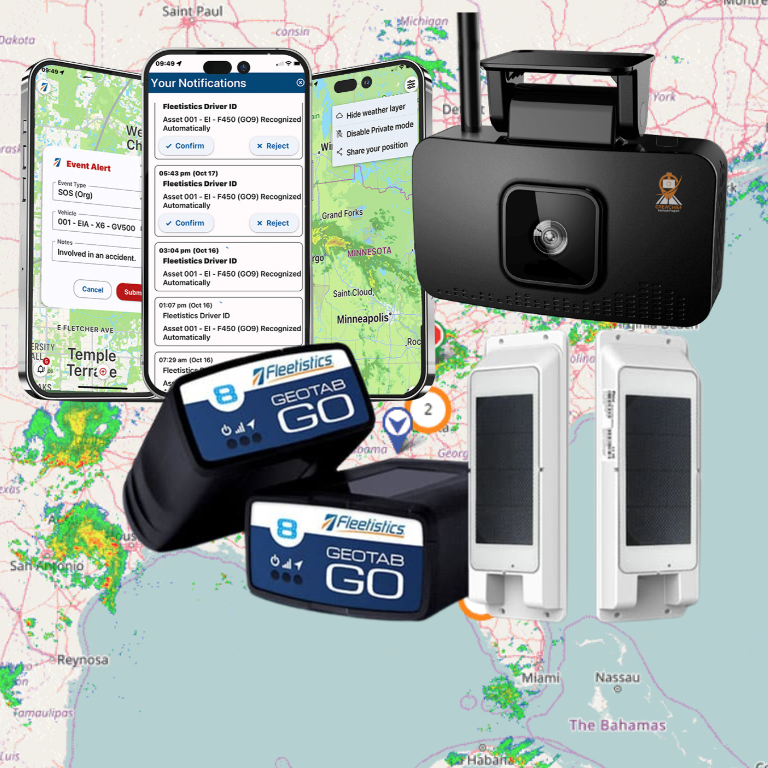
- Modular Scalable Pricing — Fleetistics uses a modular approach with five distinct platform tiers: MAP, LITE, ONE, GO, and BY IoT. You pay only for the features you need. Basic tracking starts under $1 per day, and you can scale to enterprise-level diagnostics as your operations grow.
- Hardware Guarantees — Industry standard hardware warranties last only 1 to 3 years. If a device breaks on month 37 of a 48-month contract, you must purchase replacement hardware out-of-pocket. Fleetistics eliminates this risk by offering a limited lifetime warranty on ONE and PRO platforms.
- Hidden Costs — Watch for unexpected fees that inflate the real cost of fleet software. Some vendors charge extra for API access, driver coaching features, or basic reporting. Fleetistics includes these capabilities in the platform tiers without surprise surcharges. Free API access alone can save mid-market fleets thousands annually compared to proprietary platforms.
Integration Depth: Open APIs vs Closed Ecosystems
Your fleet management software cannot operate in a vacuum. It must communicate with dispatching systems, routing tools, HR platforms, and maintenance portals. A key differentiator in this fleet management software comparison 2026 is how each platform handles your operational data.
Legacy telematics systems operate as closed ecosystems. They charge premium fees to access APIs or restrict integrations to their own proprietary partners. Geotab, the engine behind Fleetistics, is built on an open-platform philosophy from the ground up. We provide free API access and full SDK documentation, which lets your team sync vehicle data with any external system.
Additionally, the Geotab Marketplace offers over 300 pre-built integrations. These include direct connections with Fleetio for maintenance work orders, utility integrations for heavy equipment, power take-off (PTO) monitoring, and cold-chain temperature tracking. No other major fleet platform offers this depth of third-party integration at no extra API cost.
Our Pick for Most Fleets: Why Fleetistics and Geotab Win the Value Test
For mid-market operations, Fleetistics powered by Geotab provides the best balance of enterprise-grade technology and personalized support. You gain access to the same telematics engine trusted by major government fleets without the impersonal experience of dealing with a direct enterprise sales department.
Our track record speaks clearly. Fleetistics helped coordinate critical public operations for the City of Austin, which runs 7,100 vehicles and depends on our platform during severe weather emergencies like Winter Storm Uri. We delivered $2 million in documented fuel savings for the City of Seattle’s 4,100-vehicle fleet through idle reduction and route optimization strategies. The State of Utah Department of Corrections reduced its fleet by 60 vehicles through better utilization analysis, saving hundreds of thousands in annual operational costs.
These are not isolated success stories. They follow a pattern: fleets that adopt our platform typically see a 14 to 20 percent reduction in fuel costs. A 20 percent or greater improvement in driver productivity, and accident rate reductions approaching 40 percent. Most customers recover their full investment within the first 90 days of use. When you combine these outcomes with the flexibility of month-to-month billing and lifetime hardware coverage. The total cost of ownership is significantly lower than enterprise competitors over any three-year comparison window.
Whether you operate 15 service vans or a mixed fleet of 500 trucks, we tailor the system to your specific KPIs. For more implementation detail, our GPS tracking for business guide covers the exact hardware, training, and software configurations required to maximize your investment.
How to Run a 60-Day Fleet Software Evaluation Without Risk
Fleetistics developed the 60-Day Solution Evaluation Process (SEP) to let you validate the technology in your actual daily operations before committing to a purchase:
- Consultative Scope — Speak with a Fleetistics expert at 855.300.0527 to identify your primary operational challenges and choose the right devices.
- Rapid Installation — We ship pre-configured plug-and-play GPS devices to your office. Professional installation support is available nationwide.
- Structured Training — Your team receives tailored onboarding through the Fleetistics Academy, so managers and dispatchers are fully prepared on day one.
- ROI Validation — Track actual fuel savings, safety score improvements, and productivity gains over 60 days. If the system does not meet your goals, return the hardware for a full refund.
No other major fleet software provider offers a risk-free trial of this duration. Most competitors require a 3-year commitment before you can test the platform in your own operation.
Frequently Asked Questions
What is the difference between basic GPS tracking and a fleet management system?
Basic GPS tracking only records a vehicle’s geographic location and route history. A fleet management system connects location data with engine diagnostics, driver safety scoring, fuel-tax compliance (IFTA), electronic logging (ELD/DVIR), and preventative maintenance workflows to optimize your entire operation.
Are there fleet management platforms that do not require 3-year contracts?
Yes. While major competitors like Samsara and Verizon Connect lock you into rigid 36-month contracts, Fleetistics offers flexible modular billing options. You only pay for active vehicles and can scale your plan as your business demands change.
How much does fleet management software cost per month?
Fleet software pricing typically ranges from $25 to $60+ per vehicle per month when bundled with hardware from enterprise providers. Fleetistics offers options starting under $1 per day, allowing mid-market fleets to right-size their investment without overpaying for unused features.
What is the best fleet management software for mid-size fleets?
For mid-size fleets of 50 to 500 vehicles, Fleetistics powered by Geotab offers the best combination of enterprise-level features, flexible pricing, and responsive support. Our 60-day risk-free evaluation lets you validate performance before any long-term commitment.
Does fleet management software include dashcam integration?
Many platforms now offer AI dashcam integration. Fleetistics supports multi-camera AI dashcam setups that detect distracted driving, harsh braking, and collision events. These integrate directly with driver coaching and insurance documentation workflows.
Ready to see how Fleetistics compares in your real-world operation? Speak with a fleet telematics consultant today at 855.300.0527 or book a personalized platform demo to start your 60-day risk-free evaluation. Our team will help you identify the right platform tier and pricing model for your specific fleet size and operational goals.