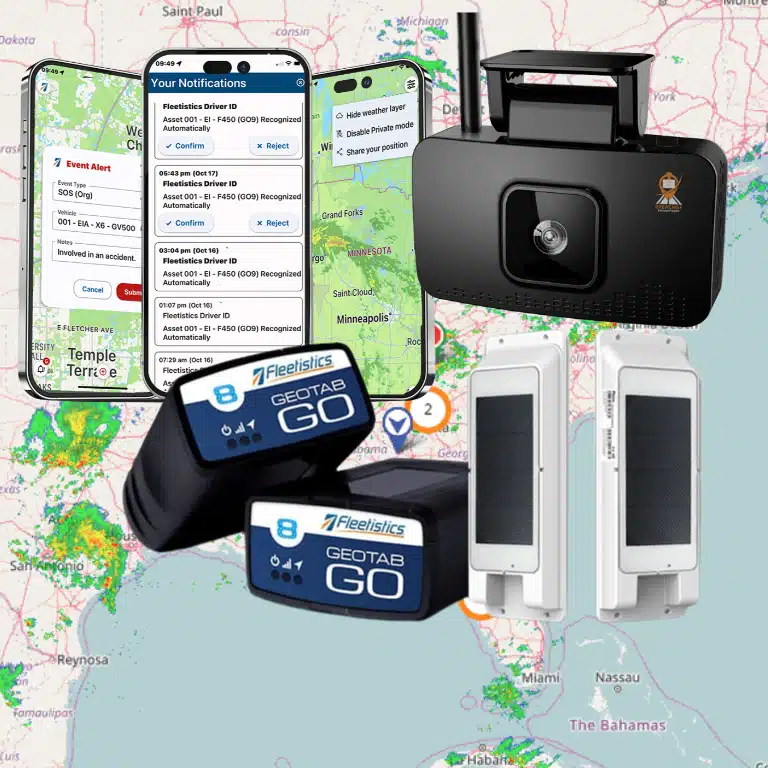

Building a DIY GPS tracking platform can sound like the perfect way to cut subscription costs and control every feature. In practice, most companies discover that the real work is not buying a tracker. It is building and maintaining the mapping, data, carrier, device, security, support, and reporting infrastructure behind the tracker.
Thinking about a custom GPS tracking system? Contact Fleetistics today or speak with a consultant at 855.300.0527 before you commit engineering budget.
Fleetistics has worked in fleet telematics since 2001. In that time, only a very small number of organizations have had the resources and business case to build their own platform successfully. Aaron from Fleetistics explains the same reality in this video: DIY GPS Tracking: Why 99% of Companies Should Never Build Their Own System.
This article breaks down why the build-versus-buy decision is harder than it appears, what hidden costs most teams miss, and when a hybrid approach can make more sense than a full in-house platform.
What does DIY GPS tracking actually require?
DIY GPS tracking means building or heavily customizing the software, data pipeline, and operational systems used to collect location data from devices and turn it into useful fleet information. The tracker is only one piece of the system.
A working fleet tracking platform usually needs all of these components:
- GPS devices that can be configured, installed, provisioned, updated, and replaced.
- SIM cards, cellular plans, carrier relationships, and data usage monitoring.
- Device programming that controls how often data is captured and transmitted.
- Servers or cloud infrastructure to receive, store, process, and secure data.
- Mapping and GIS layers that turn latitude and longitude into usable locations.
- A database structure that can handle large volumes of time-stamped vehicle events.
- A web portal or mobile interface for dispatchers, managers, and administrators.
- Reporting, alerts, permissions, audit trails, and customer support workflows.
- Ongoing maintenance when devices, carriers, browsers, APIs, and maps change.
That is why DIY fleet tracking is not just an IT project. It becomes a software company inside your fleet operation.
Why does DIY GPS tracking look cheaper at first?
DIY GPS tracking looks cheaper because the visible costs are easy to compare. A business may look at a monthly platform fee, multiply it by the number of vehicles, and assume internal development will eventually be less expensive.
The problem is that monthly subscription pricing includes many things that do not show up on a simple spreadsheet. Commercial fleet management platforms include infrastructure, device support, uptime monitoring, mapping services, mobile access, data storage, security updates, support teams, and years of product development.
When a company builds internally, those responsibilities move onto its own payroll. The costs are not eliminated. They are shifted into engineering time, project management, cloud hosting, wireless management, QA testing, cybersecurity, training, and support.
For fleets under roughly 1,000 vehicles, the math usually breaks against a custom platform. The savings from avoiding a monthly fee rarely outweigh the cost of the team needed to build and maintain a reliable system.
The hidden costs most companies underestimate
The largest DIY GPS tracking expenses are often the ones that never appear in the first budget. The initial build is only the start. The long-term cost comes from keeping the system accurate, secure, and useful every day.
Mapping and GIS complexity
Displaying a dot on a map is simple. Creating a reliable fleet map is not. A fleet platform must handle geocoding, reverse geocoding, route history, map layers, address accuracy, boundaries, zones, traffic context, and exceptions. If the map data is wrong, dispatchers and managers lose trust quickly.
Database and event volume
A single vehicle can generate thousands of records over time. Multiply that by hundreds of vehicles, multiple event types, driver assignments, diagnostics, alerts, and historical reports, and the database design becomes a core business risk. Slow queries and missing records can make the platform unusable.
SIM cards and carrier management
GPS devices need cellular connectivity. That means SIM provisioning, carrier coverage decisions, data plan negotiation, roaming behavior, deactivation workflows, billing reconciliation, and support when devices stop reporting. These tasks are operationally tedious and business critical.
Device programming and firmware
How often should the device report? What happens when the vehicle is parked? How are ignition, speeding, idling, harsh braking, power loss, and tampering events handled? Poor configuration can create too much data, too little data, or the wrong data.
Security and uptime
Fleet data can reveal vehicle locations, routes, schedules, and operational patterns. A DIY platform needs encryption, permission controls, backups, monitoring, logging, patching, and incident response. These are not optional for organizations with valuable assets or regulated operations.
Support and training
Every custom tool needs documentation, user training, troubleshooting, and internal champions. When dispatchers cannot find a vehicle or reports do not match expectations, someone has to answer the call.
Build versus buy: where the real ROI breaks
The build-versus-buy question should not start with the monthly subscription fee. It should start with the total cost of ownership.
| Cost area | Commercial fleet platform | DIY GPS tracking platform |
|---|---|---|
| Device sourcing | Supported hardware ecosystem | Internal sourcing, testing, and replacement process |
| Connectivity | Managed through established programs | SIM cards, carriers, plans, roaming, and billing |
| Mapping | Built into the platform | GIS licensing, integration, accuracy, and support |
| Data pipeline | Maintained by platform provider | Custom ingestion, parsing, storage, and scaling |
| Security | Platform-level controls and updates | Internal responsibility for controls, patches, and audits |
| Support | Vendor and reseller support | Internal help desk and engineering escalation |
| Feature growth | Roadmap and marketplace integrations | Custom development for every new requirement |
A DIY platform can make sense when the business has a unique operational requirement, a large enough fleet to spread fixed costs, and an internal team already capable of maintaining production software. Without those conditions, the organization usually accepts more risk for less capability.
Before you build, compare the full cost. Review how to choose the best GPS tracking system, then talk with Fleetistics about the lowest-investment path for your fleet.
Why fleets under 1,000 vehicles rarely break even
Fleet size matters because custom software has fixed costs. A 50-vehicle fleet and a 5,000-vehicle fleet may both need mapping, databases, security, user management, device support, dashboards, reports, and maintenance. The larger fleet has more vehicles over which to spread those costs.
Smaller and mid-size fleets often have better uses for internal resources. Instead of funding a custom telematics platform, they can focus on using fleet data to reduce fuel waste, improve driver safety, protect assets, simplify compliance, and increase productivity.
Fleetistics serves fleets across the USA, Canada, and Mexico with modular solutions that can scale as needs change. A business can start with practical GPS tracking and expand into fleet management software, dashcams, maintenance, routing, compliance, analytics, and integrations as ROI is proven.
What about total customization and control?
Customization is the strongest argument for DIY GPS tracking, but it is often misunderstood. Most companies do not need to own the entire platform to get the workflows and data they want.
Fleetistics supports an open ecosystem approach, including free API access and hundreds of integrations through the Geotab marketplace. For many businesses, that means they can connect fleet data to existing systems without rebuilding the core tracking platform.
Common integration goals include:
- Sending mileage, location, or utilization data into business intelligence tools.
- Connecting fleet data with dispatch, maintenance, fuel, accounting, or ERP systems.
- Creating custom dashboards for managers or executive teams.
- Automating reports for compliance, productivity, or cost control.
- Supporting customer-specific workflows without owning device infrastructure.
This approach gives companies more control over how they use data while avoiding the burden of maintaining every layer of the GPS tracking stack.
When a hybrid GPS tracking solution makes sense
A hybrid model can work when a company has a real need for custom applications but does not want to manage devices, SIMs, and raw data delivery alone. In that structure, Fleetistics can support the hardware, connectivity, and data delivery side while the customer builds the specialized interface or workflow it truly needs.
This is the practical middle ground for the 1% of organizations with a legitimate custom use case. They can avoid rebuilding the entire foundation and focus internal development resources on the parts that create business advantage.
Examples of hybrid use cases include:
- A large organization that already has an internal operations portal.
- A business that needs GPS data inside proprietary dispatch software.
- An enterprise team with specific data warehouse or analytics requirements.
- A specialized operation where the standard user interface is less important than reliable data delivery.
The key is to separate what must be custom from what should be proven infrastructure. For most fleets, the device, network, mapping, and data pipeline should not be custom unless there is a strong operational reason.
Questions to ask before building your own GPS platform
Before choosing a DIY GPS tracking project, ask direct questions about cost, risk, and ownership:
- Who will maintain the system after the first developer or vendor leaves?
- What uptime standard does the fleet require, and who is accountable for it?
- How will SIM cards, carriers, data usage, and device failures be managed?
- How many years of location history must be stored and searchable?
- What happens when a browser, mapping API, operating system, or device firmware changes?
- How will the system support permissions, security, backups, and audit trails?
- How quickly can the system add features like alerts, reports, mobile access, dashcams, ELD, DVIR, IFTA, or maintenance scheduling?
- What is the true five-year cost compared with a proven platform?
If those answers are unclear, the project is not ready for a build decision.
What should most companies do instead?
Most companies should buy a proven GPS tracking or fleet management platform, then configure and integrate it around their business needs. That gives the fleet reliable core infrastructure while preserving flexibility where it matters.
Fleetistics offers multiple platform tiers, from entry-level tracking to advanced fleet management and API-first data options. That matters because not every fleet needs the same system. A small service fleet may need visibility and alerts. A government fleet may need procurement support, compliance, and long-term scalability. A data-driven enterprise may need APIs and integrations.
Not sure which path fits? Explore Fleetistics IoT platform options or book a consultation to validate ROI before investing in a custom build.
FAQ: DIY GPS tracking systems
Can a company build its own GPS tracking system?
Yes. A company can build its own GPS tracking system if it has the right engineering, data, mapping, device, carrier, and support resources. The question is not whether it is possible. The question is whether it is practical and financially justified.
Why is DIY GPS tracking usually more expensive than expected?
DIY GPS tracking is usually more expensive than expected because the company must maintain infrastructure that a commercial platform already includes. This can include mapping, servers, databases, SIM cards, device management, security, reporting, user support, and future feature development.
What fleet size justifies a custom GPS tracking platform?
There is no universal fleet-size cutoff, but fleets under about 1,000 vehicles rarely have enough scale to justify a full custom platform. A custom build is more realistic for very large organizations with unique requirements and an internal technical team.
Can Fleetistics support a custom or hybrid GPS tracking project?
Yes. Fleetistics can support organizations that need a hybrid approach by helping with devices, SIMs, data delivery, and platform options. That allows the customer to build only the specialized pieces it truly needs.
What is the best alternative to building a DIY fleet tracking system?
The best alternative is to use a proven fleet management platform with configurable features, API access, and integrations. This keeps the core tracking system reliable while still allowing custom reporting, data workflows, and business-system connections.
Bottom line: build only if the business case is overwhelming
DIY GPS tracking is possible, but possible is not the same as practical. For 99% of companies, the cost, risk, and maintenance burden outweigh the savings. The better approach is to choose a proven platform, validate ROI, and use APIs or hybrid data delivery where customization is truly needed.
Fleetistics can help your team evaluate the options before you spend months building a system that already exists. Contact Fleetistics today or call 855.300.0527 to speak with a consultant.