


Automatic Vehicle Location Tracking System
Overview of Automatic Vehicle Location Technology
Unlock Efficiency, Control Costs, and Drive Success.
Automatic Vehicle Location (AVL)
Automatic vehicle location is a means for determining the geographic location of a vehicle and transmitting this information to a point where it can be used.
Most commonly, the location is determined using GPS and the transmission mechanism is a satellite, terrestrial radio or cellular connection from the vehicle to a radio receiver, satellite or nearby cell tower.
The tracking data is then transmitted using any one of a variety of telemetry systems. GSM and EVDO are the most common technologies used for telemetry because of the low data rate needed for AVL. The low bandwidth requirements also allow for satellite technology to receive telemetry data at a moderately higher cost, but across a global coverage area and into very remote locations not well-covered by terrestrial radio or public carriers.
Fleet management visibility makes automatic vehicle location a powerful tool for managing fleets
Vehicles such as service vehicles, emergency vehicles, and construction equipment and public transport vehicles (buses and trains) are all using automatic vehicle location (AVL) systems or GPS tracking systems. It also is used to track mobile remote assets such as construction equipment, trailers, and portable power generators.
Types Of AVL Systems
Direction Finding
Amateur radio and some cellular or PCS wireless systems use direction finding or triangulation of transmitter signals radiated by the mobile. This is sometimes called radio direction finding, or RDF. The simplest forms of these systems calculate the bearing from two fixed sites to the mobile. This creates a triangle with endpoints at the two fixed points and the mobile. Trigonometry tells you roughly where the mobile transmitter is located. In wireless telephone systems, the phones transmit continually when off-hook, making continual tracking.
Signpost Systems
To track and locate vehicles along fixed routes, a technology called signpost transmitters was employed. This is used on transit routes and rail lines where the vehicles to be tracked continually operated on the same linear route. A transponder or RFID chip along the vehicle route would be polled as the train or bus traverses its route. As each transponder was passed, the moving vehicle would query and receive an ark, or handshake, from the signpost transmitter. A transmitter on the mobile would report passing the signpost to a system controller. These systems are an alternative inside tunnels or other conveyances where GPS signals are blocked by terrain.
GPS Based
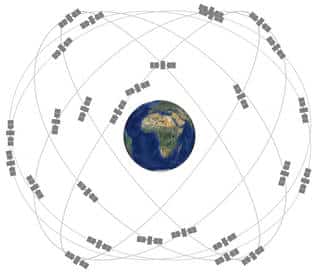
The low price and ubiquity of Global Positioning System or GPS equipment has lent itself to more accurate and reliable telelocation systems. GPS signals are impervious to most electrical noise sources and don’t require the user to install an entire system. Only a receiver to collect signals from the satellite segment is installed in each vehicle and a radio to communicate the collected location data with a dispatch point is typically used.
Large private telelocation or automatic vehicle location (AVL) systems send data from GPS receivers in vehicles to a dispatch center over their private, user-owned radio backbone. These systems are used for businesses like parcel delivery and ambulances. Location data is periodically polled from each vehicle in a fleet by a central controller or computer. In the simplest systems, data from the GPS receiver is displayed on a map, allowing people to determine the location of each vehicle. More complex systems feed the data into a computer-assisted dispatch system, which automates the process.
How Automatic Vehicle Location Systems Work
Automatic Vehicle Location, or AVL, is a setup that reports a vehicle’s position back to a central dashboard. Most avl systems use GPS plus a cellular connection to send real time location data at set intervals. Dispatch sees each unit’s real time location and exact location on a map, along with basic status signals like moving, stopped, or idling. In larger deployments, AVL pairs with computer aided dispatch so the dispatcher can assign the closest unit, adjust coverage, and keep service moving when conditions change.
This is especially common for transit vehicles and public fleets, where agencies need consistent updates across long routes and multiple depots. AVL can also push data into customer facing tools, including mobile apps, when a system supports rider updates and ETA sharing.
Benefits of Automatic Vehicle Location for Fleets
AVL improves fleet management because it replaces guesswork with real time visibility. When you can monitor vehicles continuously, it becomes easier to spot route drift, missed turns, and long dwell times, then optimize routes without waiting for end of day reporting. Over time, this supports optimizing route planning and strengthens operational efficiency because dispatch decisions happen faster and drivers spend less time backtracking.
AVL can also help reduce fuel consumption by tightening routes, cutting idle time, and limiting unnecessary miles. Service teams often see better arrival accuracy, which can improve service quality and protect overall service quality in high volume operations. For public sector use cases, AVL plays a big role in emergency services, where dispatch needs fast unit selection and reliable location awareness during response and coverage planning.
Frequently Asked Questions
What Is Automatic Vehicle Location (AVL)?
AVL is a vehicle tracking approach that provides real time vehicle tracking through cable systems, typically using GPS and wireless communications to share real time location data with dispatch and operations teams.
How does an automatic vehicle location system work?
A device in the vehicle captures GPS coordinates and transmits the exact location as real time location data to a central platform, often integrated with computer aided dispatch for faster routing and assignment.
What types of vehicles can use AVL systems?
Most fleets can use AVL, from service vans to trucks, as well as transit vehicles used by transit agencies running fixed route or demand response programs within transit systems.
Is automatic vehicle location the same as GPS tracking?
AVL typically relies on GPS, but “AVL” usually refers to the operational layer, meaning dispatch visibility, mapping, and workflow integration, not just raw GPS pings. In practice, AVL is often the system used to turn GPS data into usable fleet oversight.